How Do I Build the Right Routine?
The midlife protocol. Simpler, more strategic, and more effective than anything you tried at 35.

Most women in midlife are using too many products, in the wrong order, with the wrong actives. Not because they’re careless, but because the skincare industry has spent twenty years telling them “more, stronger, deeper.” In midlife, that approach is almost exactly wrong.
This section is the protocol. What to apply first, what comes next, which ingredients play well together, and which ones need to be separated. How much to use. How often. The morning routine and the evening routine, both worked out for skin that’s in the specific biological state of perimenopause or menopause — not for skin that belonged to someone ten years younger. Simpler than you think. More effective than you’ve experienced.
Q & A List
The questions other women are asking right now.
What’s the best skincare routine for menopause?
What’s the best skincare routine for menopause?
The best skincare routine for menopause is barrier-first, peptide-led, and intentionally streamlined. A strong routine has five elements: a gentle low-pH cleanser, a vitamin C serum in the morning, a peptide-rich treatment in the evening, a triple-lipid moisturiser morning and evening, and daily SPF. Five products, applied consistently, doing what midlife skin actually needs.
The five essential elements
1. A gentle, low-pH cleanser. In your 30s, a foaming sulfate cleanser was fine. In midlife, it strips lipids your skin can no longer easily replace. Switch to a probiotic, low-pH cleanser that respects the microbiome.
2. A vitamin C serum, morning only. Vitamin C does three things midlife skin needs: inhibits melanin production (preventing pigmentation), neutralises free radicals from UV and pollution, and supports collagen synthesis. Used under SPF, it’s your daytime protection layer.
3. A peptide-rich treatment, evening. Specifically GHK-Cu (copper peptides), which signal collagen and elastin production without irritation. This is the structural rebuilding step.
4. A triple-lipid moisturiser, morning and evening. Ceramides + cholesterol + free fatty acids — the three lipid classes that make up the barrier’s mortar. Replacing only one (most “ceramide moisturisers”) is incomplete. The full triple-lipid formulation is what midlife skin needs to fully repair.
5. Daily SPF. Mineral, broad-spectrum, SPF 30 minimum. Indoor as well as outdoor — visible light from windows triggers pigmentation. Without daily SPF, no other product in your routine works as well as it could.
Morning vs evening structure
Morning:
- Gentle cleanse (or just rinse with water if skin is sensitive)
- Vitamin C serum
- Niacinamide or barrier-supportive serum (optional but recommended)
- Triple-lipid moisturiser
- SPF
Evening:
- Gentle cleanse (double cleanse if wearing SPF and makeup)
- GHK-Cu peptide serum
- Bakuchiol oil or treatment (optional)
- Triple-lipid moisturiser
The three principles
Barrier-first. Every product in the routine should support, not test, the barrier. Anything that strips, irritates, or sensitises gets removed.
Peptide-led. The structural changes in midlife skin (collagen loss, elastin breakdown, dermal thinning) respond to peptides. They’re the active that does the most work for the least irritation.
Streamlined. Five elements, not fifteen. Fewer products, more consistent use, better results. The 10-step trend routines were built for skin in its 20s - for midlife biology, simpler is more effective.
What to skip
- High-percentage retinol (over 0.5%) - switch to bakuchiol or low-percentage retinal.
- Fragrance and essential oils - common sensitisers for the midlife barrier. Includes “natural” essential oils like lavender, citrus, rose, and tea tree.
- Sulfate cleansers - strip the lipid barrier.
- Daily exfoliating acids - once or twice a week is sufficient.
- Multi-step trend routines - 7-step, 10-step routines aren’t designed for midlife biology.
Where Pure & Cimple fits
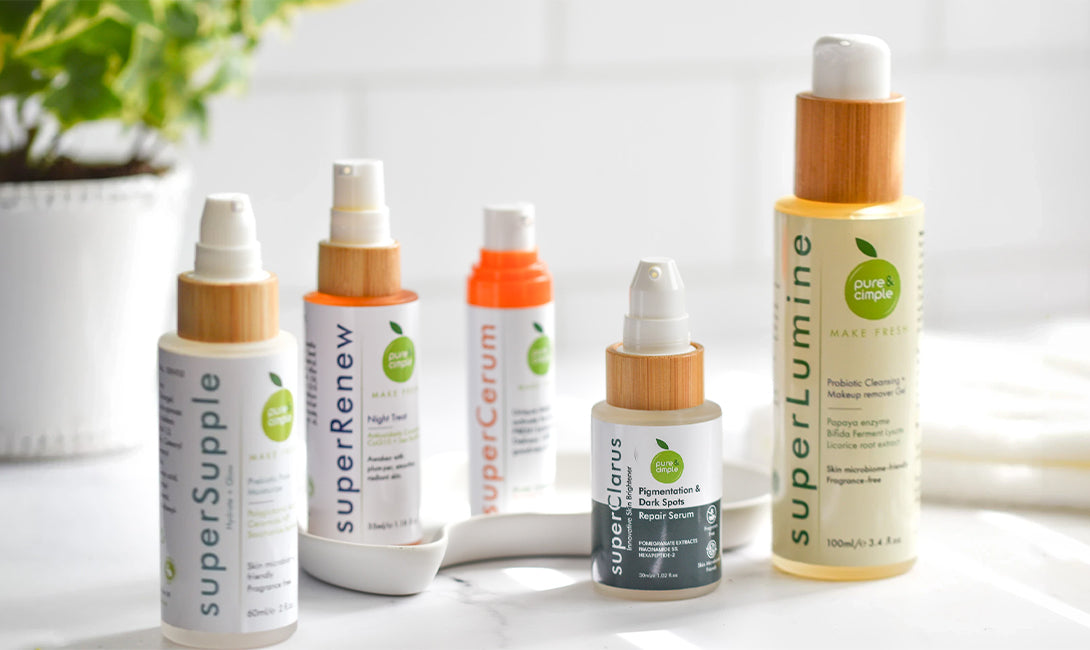
Every Pure & Cimple product is designed to be part of this routine — barrier-first, fragrance-free, essential-oils-free, microbiome-friendly. The complete routine looks like this:
Morning:
Step 1: superLumine (cleanser)
Step 2: superCerum (vitamin C with ferulic acid) OR superPeptide (1% GHK-Cu serum)
Step 3: superSupple (triple-lipid barrier moisturiser)
Step 4: SPF.
Evening:
Step 1: superLumine (cleanser)
Step 2: superClarus (pigmentation/peptide serum) OR superPeptide (1% GHK-Cu serum)
Step 3: superRenew (bakuchiol oil)
AND / OR
Step 4: superSupple (triple-lipid barrier moisturiser).
Four products in the morning, four in the evening. Every product designed for the biology midlife skin actually has, not the biology it had ten years ago.
Can I mix vitamin C and niacinamide?
Can I mix vitamin C and niacinamide?
Yes - you can absolutely use vitamin C and niacinamide together. The old myth that they cancel each other out has been thoroughly debunked. The two are complementary: vitamin C brightens and protects; niacinamide strengthens the barrier and calms inflammation. Use them in the same routine, layered, or even in the same product. All three work.
Where the myth came from
The “vitamin C and niacinamide cancel each other out” claim originated in a 1960s study using impure forms of both ingredients at high concentrations and high heat. Under those conditions, the two reacted to form niacin (the form of vitamin B3 that causes the “niacin flush” - temporary skin redness).
Modern skincare formulations don’t have this problem. The vitamin C in current serums is stabilised L-ascorbic acid or one of its derivatives. The niacinamide is purified. At skincare concentrations and normal application temperatures, the two simply don’t react in any meaningful way.
This has been confirmed by every credible dermatology study since the 1990s. The myth lingers in skincare advice columns, but it’s not based on current science.
Why they’re actively complementary
The two ingredients work through different mechanisms and address different concerns - which means using them together gives you broader coverage than either alone.
Vitamin C:
- Inhibits tyrosinase, the enzyme that produces melanin (reduces and prevents pigmentation).
- Neutralises free radicals from UV and pollution.
- Supports collagen synthesis.
- Brightens overall skin tone.
Niacinamide:
- Reduces transfer of melanin from melanocytes to skin cells (a different mechanism than vitamin C).
- Strengthens the skin barrier.
- Reduces inflammation.
- Regulates oil production.
- Improves skin elasticity.
Together, they hit pigmentation through two distinct pathways — vitamin C reducing production, niacinamide blocking transfer. That’s more effective than either alone.
How to use them together
Three valid ways:
1. Same routine, separate products. Vitamin C serum first (it’s most effective at slightly acidic pH), then niacinamide serum or moisturiser with niacinamide. Wait 30 seconds between to let the vitamin C settle, but you don’t need to wait longer.
2. Layered immediately. Apply both within seconds of each other. No reaction, no efficacy loss.
3. In the same product. Many modern serums include both vitamin C and niacinamide together. The combination is stable and effective.
For midlife skin specifically, morning is the best time for both — vitamin C protects against daytime UV and pollution; niacinamide reinforces the barrier through the day. Layered under SPF, you have a strong morning protection routine.
What does pair poorly with vitamin C (it’s not niacinamide)
Two ingredients to actually keep separate from vitamin C:
Copper peptides (GHK-Cu). Vitamin C’s acidity can chelate the copper ion and reduce peptide efficacy. Use vitamin C in the morning, GHK-Cu at night.
Retinoids. The combination is irritating for many people. Use vitamin C morning, retinol or bakuchiol evening.
Niacinamide doesn’t have either of these problems. It’s one of the most compatible ingredients in skincare.
Where Pure & Cimple fits
Vitamin C is the active in superCerum (with ferulic acid for enhanced stability and synergistic antioxidant action). Niacinamide is included across multiple Pure & Cimple formulations as part of our barrier-supportive philosophy. They work together in the morning routine - superCerum first, then any of our moisturisers, all of which contain barrier-supportive ingredients. No reaction, no efficacy loss, more pigmentation control than either alone.
What order should I apply my skincare in?
What order should I apply my skincare in?
The general rule is thinnest to thickest, water-based to oil-based. Products with smaller molecules go first so they penetrate the skin; richer occlusive products go last so they seal everything in. The standard order: cleanser → toner (optional) → water-based serum / treatment serum → eye cream(optional) → moisturiser / face oil → SPF (morning only).
The thinnest-to-thickest principle
The order matters because of how skincare actually penetrates skin. Smaller molecules (water-based, lighter consistency) penetrate further when applied first. Larger molecules and occlusive ingredients (oils, balms, heavier creams) sit on top and form a barrier - apply them too early and you block lighter products from getting where they need to go.
A useful way to think about it: liquids before lotions, lotions before creams, creams before oils.
The standard order
1. Cleanser. Removes dirt, oil, SPF, makeup. Sets a clean baseline. Use a gentle, low-pH, non-stripping cleanser for midlife skin.
2. Toner (optional). Resets skin pH after cleansing. Skip if you’re using a low-pH cleanser; the pH-correcting work is already done.
3. Treatment serum (vitamin C in the morning, GHK-Cu peptide in the evening). The active ingredients that do the structural work. These need direct contact with skin and shouldn’t be blocked by any layers above.
4. Eye cream (optional). Apply to the orbital bone, not directly under the eye, with a tapping motion. Goes before moisturiser so the eye area gets dedicated treatment.
5. Moisturiser. Triple-lipid barrier repair moisturiser is what midlife skin needs. Forms the primary lipid layer, locks in everything beneath.
6. Face oil (optional, evening). Goes on top of moisturiser. Oils can penetrate cream but not the other way around. If you use bakuchiol, retinol, or another treatment oil, it goes here.
7. SPF (morning only). Last layer. Always. SPF goes on TOP of moisturiser, never beneath, because the SPF film needs to be the outermost layer to actually work.
The pH timing rule
One nuance worth knowing: acidic actives (vitamin C at low pH, AHAs, BHAs) work best on freshly cleansed skin at the right pH. Most modern formulations are stable enough that you don’t need to wait between layers - but if you’re using a low-pH vitamin C serum and then a higher-pH product immediately, give 30 seconds between them so the vitamin C has time to settle.
Morning vs evening differences
Both routines follow the same thinnest-to-thickest principle — the actives just shift.
Morning is about protection: cleanser (light) → vitamin C → moisturiser → SPF.
Evening is about repair: cleanser (thorough) → peptide serum → treatment oil / moisturiser. No SPF.
Common mistakes
- Putting moisturiser before serum. The serum can’t penetrate through the moisturiser layer. Always serum first.
- Putting SPF under moisturiser. SPF needs to be the outermost layer; covered by another product, the protection drops.
- Using oil before serum. Oil blocks water-based products from penetrating. Oil last (or near-last, before SPF).
- Layering too many actives at once. Three actives in one routine is plenty. Five or six is too many for midlife skin to tolerate.
The simplification rule
If you’re not sure whether a product belongs in your routine: skip it for a week and see if your skin notices. Most midlife skincare is overbuilt. Five well-chosen products applied in the right order outperform fifteen products applied in the wrong order, every time.
Where Pure & Cimple fits
A working morning routine: superLumine (cleanser) → superCerum (vitamin C) / superPeptide (GHK-Cu serum)→ superSupple (triple-lipid moisturiser) → SPF.
A working evening routine: superLumine (cleanser) → superPeptide (GHK-Cu serum) / superClarus (brightening serum) → superRenew (bakuchiol oil) / superSupple (triple-lipid moisturiser).


Restore what midlife takes

superPeptide | GHK Copper Peptide Serum

superSupple Prebiotic Triple Lipid Moisturizer


superLumine Probiotic Cleanser + Makeup Remover

superClarus Innovative Skin Brightener Serum




Vēda-Led. Science-Perfected. Restore what midlife takes.