Here is a fact most skincare brands would rather you didn't know: by the time you notice your skin has changed in midlife, the structural decline is already well underway.
Research shows that skin loses up to 30% of its collagen in the first five years after menopause—roughly 2% per year, starting as early as perimenopause. You see it as a softening of definition, lines that appear where none existed, and skin that no longer "bounces back."
Most anti-aging skincare responds to this with volume—heavier creams and more layers. But collagen loss isn't a hydration problem. It’s a biology problem. To fix it, we don't need to push harder from the outside; we need to speak the skin's own language.
The Blue Revolution begins soon. Here is why GHK-Cu is the breakthrough your midlife skin has been waiting for.
What is GHK-Cu? (The "Repair Signal")

GHK-Cu (Copper Tripeptide-1) is a naturally occurring complex in human plasma that acts as a biological "architect." When the body is damaged, GHK-Cu concentrations rise to trigger tissue repair. It tells the skin one thing: rebuild.
The problem? GHK-Cu levels decline sharply with age. By age 60, your plasma concentrations have dropped by roughly 60%. This is why skin regenerates more slowly and loses its structural integrity in midlife—the signal to rebuild is simply too quiet.
Topical GHK-Cu reactivates that signal.
Why GHK-Cu is Essential During Menopause
Estrogen plays a protective role in the skin that most women don’t realize until it’s gone. It maintains collagen density, regulates sebum, and supports the moisture matrix. When estrogen levels fall, these functions weaken simultaneously.
GHK-Cu addresses these shifts by working with your biology:

1. Stimulates Collagen I, III, and VI: The specific structural proteins responsible for skin density.
2. Promotes Elastin: Restoring the "spring-back" quality that diminishes in perimenopause.
3. Remodels the Matrix: It doesn't just add collagen; it cleans out "stiff," damaged fibers and replaces them with high-quality structure.
4. Anti-Inflammatory Action: It calms the "inflammaging" (chronic low-grade irritation) that accelerates aging in reactive, hormonal skin.
The GHK-Cu + Hyaluronic Acid Synergy

Collagen gives skin its structure, but Hyaluronic Acid (HA) gives that structure its volume. Addressing one without the other is like rebuilding a house but leaving the rooms empty.
In our upcoming formulation, we have paired 1% Pure GHK-Cu with a multi-weight Hyaluronic Acid system. The HA restores the moisture environment, while the GHK-Cu signals the structural repair. Together, they address both the thinning and the dryness of mature skin in parallel.
GHK-Cu vs. Retinol: The Intelligent Choice for Sensitive Skin

Many women find that the retinol they used in their 30s suddenly becomes "too much" during menopause. As the skin barrier thins, retinol can cause redness, peeling, and chronic sensitivity.
GHK-Cu offers a "Barrier-First" alternative. It triggers collagen synthesis through a pathway the skin already knows, without the "purge" period or the irritation risk. It is a hormone-friendly, non-aggressive way to achieve firming results.
What to Expect: The 12-Week Architectural Journey

Peptides are cumulative. Unlike an acid peel that gives an instant (but temporary) glow, GHK-Cu supports a biological process.
Weeks 1-8: Barrier reset, Redness reduced, Skin Texture improved, hydration levels enhanced.
Weeks 8–12: Measurable improvements in skin firmness and the appearance of fine lines.
The Wait is Almost Over
In two days, we are launching superPeptide GHK-Cu + HA Pro-Collagen Serum. Unlike "marketing doses" found elsewhere, we utilized 1.0% Pure Crystalline GHK-Cu powder - the clinical threshold required to truly move the needle on mature skin density. No dyes, no fragrance—just the deep sapphire blue of high-purity copper.
Be the first to experience the Blue Revolution. Launching .April 7th.

Frequently Asked Questions
What is GHK-Cu in skincare?
GHK-Cu (glycine-histidine-lysine copper, or copper tripeptide-1) is a naturally occurring copper peptide complex that mimics the body's own tissue-repair signal. In skincare, it is used to stimulate collagen and elastin synthesis, support skin regeneration, and reduce the inflammation associated with skin ageing. It is one of the most clinically studied peptides in dermatology.
Is copper peptide (GHK-Cu) good for menopausal skin?
Yes - GHK-Cu is particularly relevant for skin in perimenopause and menopause. Oestrogen decline accelerates collagen loss, slows skin regeneration, and compromises barrier function. GHK-Cu addresses the collagen rebuilding pathway directly, works without the irritation risk of retinol (which many midlife women can no longer tolerate), and has anti-inflammatory properties that benefit reactive, sensitised skin during hormonal transition.
Is GHK-Cu hormone-disrupting?
No. GHK-Cu is a biomimetic peptide that works on the skin’s structural repair signals. It does not interfere with your hormonal system, making it a safe, hormone-friendly choice for perimenopause and menopause.
Why is the serum blue?
The deep sapphire blue is the natural color of high-purity GHK-Cu. If a copper peptide serum is clear, it likely contains a very low concentration. Our 1% concentration results in a rich blue that guarantees potency.
Can I use this with my current Pure & Cimple routine?
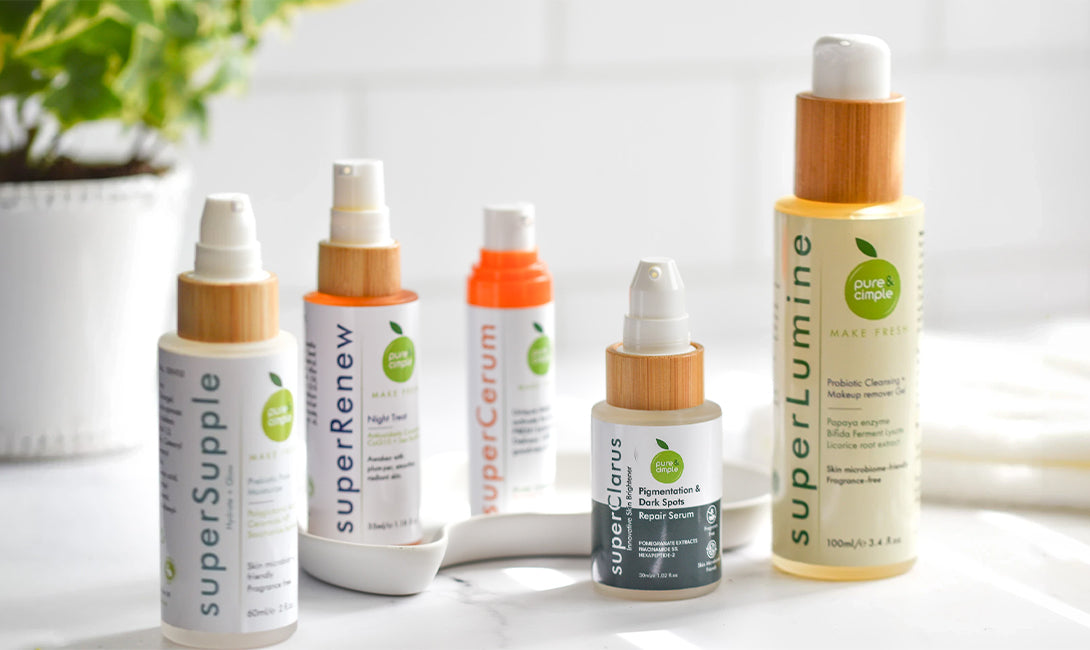
Absolutely. It fits perfectly after cleansing (superLumine) and before your skin barrier moisturizer (superSupple). Just remember: do not mix it in the same routine as superCerum - Pure Vitamin C.
Is it safe for pregnancy and breastfeeding? Yes. Unlike Retinol, GHK-Cu is considered safe for use during pregnancy, making it an excellent alternative for maintaining collagen support.
What is Pro-collagen serum?
A pro-collagen serum is formulated to support the skin's own collagen production - rather than adding collagen from an external source (which, in topical form, cannot penetrate the skin effectively). Ingredients like GHK-Cu and peptides are pro-collagen actives because they signal or support the skin's biological collagen synthesis pathway.