What’s Happening to My Skin?
The biology of midlife skin, in plain language - so nothing about this feels mysterious any more.

If you’re in your 40s or 50s and your skin suddenly feels like it belongs to someone else, you’re not imagining it. Perimenopause and menopause change almost every aspect of how your skin behaves - barrier function, collagen, pigmentation, microbiome, sebum balance - and almost no skincare brand explains it honestly.
This is the foundation section. Start here if your skin has shifted and you want to understand why before you change what you’re doing about it. None of what’s happening is a failure. All of it has a biological explanation, and all of it responds to the right approach. Let’s begin.
Q & A
The foundational questions for perimenopause and menopause skin
What is perimenopause skin, and how is it different?
What is perimenopause skin, and how is it different?
Perimenopause skin is skin responding to the hormonal shift that begins in a woman’s late 30s or 40s, when oestrogen levels start to fluctuate and eventually decline. It behaves differently from the skin you had at 30 because four of its core systems - barrier function, collagen production, pigment regulation, and microbiome balance — all begin slowing down or destabilising at the same time. Nothing is wrong with your skin. It is simply working under new biological rules.
The four systems that change
1. Barrier function. Your skin’s protective outer layer relies on ceramides, fatty acids and cholesterol - lipids whose production is supported by oestrogen. When oestrogen fluctuates, ceramide synthesis slows. The barrier becomes thinner, more permeable, and less able to hold moisture. This is why dryness, sensitivity and reactivity often appear together in perimenopause.
2. Collagen. Around 30% of skin’s collagen is lost in the first five years after menopause begins, with another 2% lost per year after that. Perimenopause is when this loss accelerates — fine lines deepen, skin elasticity reduces, and that “bouncy” quality you took for granted at 35 begins to fade.
3.Pigment regulation. Oestrogen helps regulate melanocytes, the cells that produce skin pigment. As oestrogen levels become unstable, melanocytes become more reactive — meaning sun exposure, heat, stress or inflammation can trigger pigmentation patches that wouldn’t have appeared a decade ago. Melasma in particular tends to surface or worsen in perimenopause.
4. Microbiome. Your skin’s bacterial community supports immune function, controls inflammation, and helps maintain barrier integrity. Hormonal shifts disrupt this community - beneficial strains decline, opportunistic strains expand, and inflammation increases. This is one reason perimenopausal skin often becomes more reactive even to products you’ve used for years.
How perimenopause skin is different from skin in your 30s
In your 30s, your skin has a deep buffer of resilience: high lipid production, robust collagen turnover, strong barrier integrity. You can use a stripping cleanser or a strong active and your skin recovers overnight.
In perimenopause, that buffer is thinner. The fragranced moisturiser or essential-oil-rich face oil that smelled wonderful at 32 may now leave your barrier compromised for days. The retinol you tolerated for years may suddenly trigger persistent redness. Heavy creams that worked at 35 may now sit on the surface because the deeper hydration mechanism - your hyaluronic acid and ceramide reservoir - has shrunk.
The shift isn’t a problem to be fixed. It’s a new context that requires a new strategy: gentler, more barrier-supportive, more peptide-led, and intentionally simpler.
When does it start, and how long does it last?
Perimenopause typically begins in your early-to-mid 40s, though some women experience early shifts in their late 30s. It lasts an average of 4–8 years before menopause itself (defined as 12 consecutive months without a period). Skin changes can begin before any other symptom of perimenopause - sometimes years before -which is why so many women are confused when their skin starts behaving differently.
What this means for your skincare
You don’t need more products. You need different ones, combined more strategically. The fundamentals: protect the barrier, signal collagen repair, calm reactivity, and skip ingredients that worked at 30 but now do more harm than good. That’s the foundation we built in every Pure & Cimple formulation.
Why did my skincare stop working in my 40s?
Why did my skincare stop working in my 40s?
Your skincare stopped working because your skin’s biology changed - not because your products got worse. Falling oestrogen depletes ceramides, collagen, and hyaluronic acid production, which means the same routine now has to work on a barrier that’s weaker, a structure that’s thinner, and a moisture reservoir that’s smaller. The products didn’t fail; the skin underneath them did.
The shift, in plain terms
Three things happen in your skin from your early 40s onward, and they all happen at once:
1. Barrier weakens. Ceramides, the lipids that hold the outer layer of your skin together, drop. Without them, water escapes more quickly, irritation registers more sharply, and the skin loses its ability to seal actives in.
2. Structure thins. Collagen and elastin, the proteins responsible for skin density and bounce, decline rapidly - up to 30% in the first five years post-menopause. The serum that used to plump now has less internal scaffolding to plump.
3. Hydration reservoir shrinks. Hyaluronic acid synthesis slows. The deeper water-holding mechanism your skin relied on at 30 is now half what it was. Topical hydrators sit on the surface and evaporate.
This is why the moisturiser that kept your skin glowing for fifteen years suddenly feels heavy or ineffective. The product hasn’t changed. The biological context it’s working in has.
Why “stronger” doesn’t fix it
The instinct, when something stops working, is to push harder: a more aggressive retinol, a higher-percentage acid, an exfoliating treatment. That instinct is exactly wrong for midlife skin.
In your 30s, your barrier could absorb the friction of strong actives because the ceramide buffer was thick. In your 40s, the same actives strip a barrier that’s already compromised, accelerating dryness, redness and sensitivity. “Inflammaging” - chronic low-grade irritation - does more damage to mature skin than almost any single environmental insult.
What does work
A barrier-first, peptide-led approach. Specifically:
- Ceramides and lipids to rebuild the outer layer your skin can no longer produce in adequate quantities.
- Bakuchiol instead of retinol, which signals the same collagen pathway without the irritation.
- Copper peptides (GHK-Cu), which signal structural repair rather than forcing exfoliation.
- Probiotic and prebiotic ingredients to restore the microbiome.
- Ectoin to protect against the environmental stressors (UV, heat, pollution) midlife skin is more vulnerable to.
- Niacinamide for daily barrier support and pigment regulation.
What to skip
Equally important as what you add is what you remove. The categories of ingredients that worked in your 30s but actively work against midlife skin:
Synthetic fragrance and natural essential oils. Both are common skin sensitisers, and a barrier that’s already compromised by hormonal change reacts to them more sharply than it did a decade ago. The trap many women fall into here: assuming “natural” means safer. Many clean and natural skincare brands lean heavily on essential oils for scent — which can be more irritating than synthetic fragrance for sensitive, reactive midlife skin. Lavender, rose, citrus oils, tea tree, peppermint — all common skin sensitisers, all marketed as gentle. Pure & Cimple is deliberately fragrance-free and essential-oils-free across every formulation. The mild scent in our products comes from the active ingredients themselves, not from added perfume.
High-percentage retinol. The pathway works; the dose your skin tolerated at 32 is now too aggressive. If you want the collagen-signalling benefit, switch to bakuchiol or a low-percentage retinal.
Stripping cleansers and sulfate-heavy face washes. These over-clean a barrier that’s already losing lipids. A gentle, low-pH probiotic cleanser is what midlife skin actually needs.
Denatured alcohol high in the ingredient list. A common issue in toners and “clarifying” products. Dries out and disrupts the barrier.
Frequent exfoliating acid use. AHAs and BHAs have a place, but daily exfoliation is too much for midlife skin. Once or twice a week is sufficient.
Why most “anti-ageing” products miss this
Most anti-ageing skincare is formulated for the volume model: more actives, stronger doses, faster results. That model was built for women in their 30s who could absorb the impact. For women in midlife, it accelerates the very damage you’re trying to prevent.
The right products for your 40s and beyond are simpler, gentler, more strategically combined, and chosen for the biology you have now — not the biology you had a decade ago. That’s the entire premise Pure & Cimple was built on.
What does oestrogen have to do with my skin?
What does oestrogen have to do with my skin?
Oestrogen is one of the most important hormones for skin health. It drives collagen production, supports ceramide synthesis, regulates melanin, and maintains elasticity and hydration. When oestrogen declines, all four systems slow at once - which is why midlife skin can feel like four problems showing up simultaneously rather than one.
The four roles of oestrogen in skin
1. Collagen production
Oestrogen receptors in skin fibroblasts (the cells that produce collagen) are actively involved in signalling collagen synthesis. When oestrogen levels drop, this signal weakens. The result is the well-documented 30% collagen loss in the first five years after menopause — and the slow, accelerating decline that happens in perimenopause before menopause is reached.
2. Ceramide and lipid synthesis
Oestrogen supports the production of the lipids that make up your skin’s barrier — ceramides, fatty acids, cholesterol. When oestrogen fluctuates, lipid production becomes inconsistent. The barrier becomes thinner and more permeable, leading to dryness, sensitivity, and reactivity.
3. Melanin regulation
Oestrogen helps stabilise melanocyte activity. As oestrogen becomes erratic, melanocytes become more reactive to triggers like UV exposure, heat, inflammation and stress. This is why many women see new pigmentation, melasma flare-ups, or persistent uneven tone for the first time in their 40s.
4. Skin hydration and elasticity
Oestrogen contributes to hyaluronic acid synthesis (which holds moisture in the dermis) and supports elastin (which gives skin its bounce-back quality). Both decline alongside oestrogen — which is why midlife skin can feel simultaneously dry and slack, even with the same skincare you’ve used for years.
Why this is overlooked in standard skincare advice
For decades, skincare has been built around external factors: sun exposure, pollution, sleep, hydration, stress. All real, all important. But for women in midlife, the dominant variable is internal - and most skincare advice doesn’t account for it.
A 47-year-old woman is not a 35-year-old who needs slightly stronger anti-ageing products. She is a woman whose skin is operating under a different hormonal blueprint. Effective skincare for her body has to start with that fact, not work around it.
What you can actually do (skincare side)
This is not a piece of advice about HRT - that’s a conversation for you and a clinician you trust. From a skincare perspective:
- Replace the ceramides your skin can no longer produce at adequate levels (look for products with biomimetic ceramides or a ceramide-cholesterol-fatty acid blend).
- Signal collagen repair without irritating the barrier (peptides like GHK-Cu, bakuchiol).
- Use barrier-supportive actives daily (niacinamide, panthenol, beta-glucan).
- Protect against environmental triggers that now hit harder (broad-spectrum SPF, ectoin, antioxidants).
- Skip fragrance and essential oils. Both are common skin sensitisers, and midlife skin’s compromised barrier reacts to them more sharply than it did a decade ago. This includes the “natural” essential oils in many clean-beauty brands — lavender, citrus, rose, tea tree — which can be more irritating than synthetic fragrance. Pure & Cimple formulations are deliberately fragrance-free and essential-oils-free for this reason.
- Skip the harsh actives and stripping routines that worked in your 30s.
The honest summary
Oestrogen does more for your skin than most skincare brands will tell you. When it declines, the changes are real, biological, and predictable. They are also responsive — to the right ingredients, used the right way, in a routine designed for the body you have now.


Restore What Midlife Takes

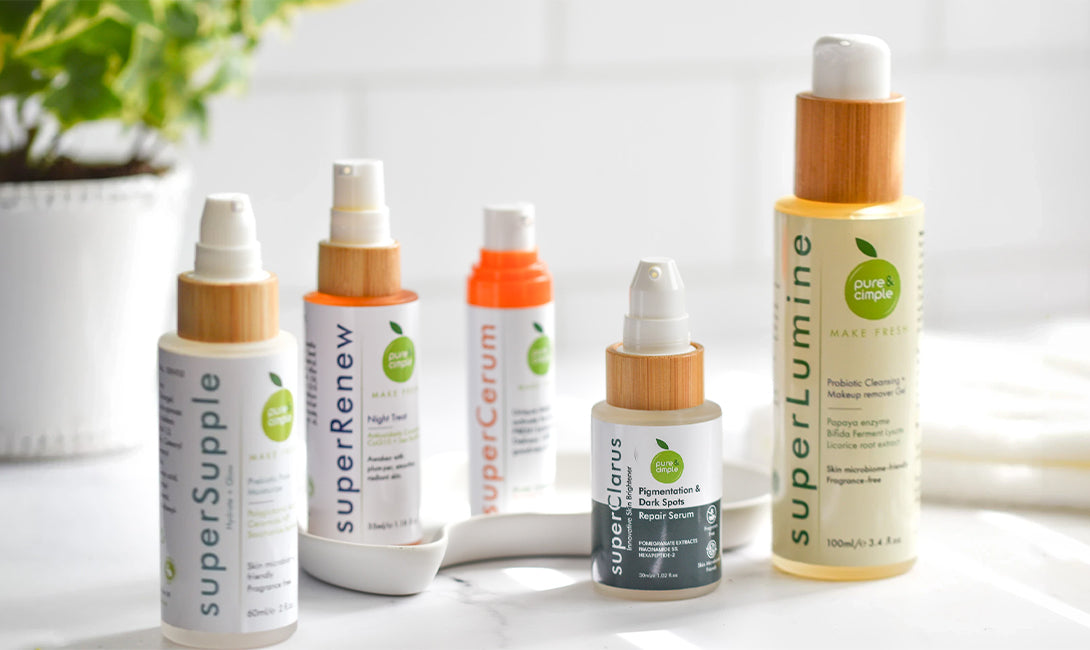
superPeptide | GHK Copper Peptide Serum

superSupple Prebiotic Triple Lipid Moisturizer


superLumine Probiotic Cleanser + Makeup Remover

superClarus Innovative Skin Brightener Serum


Vēda-Led. Science-Perfected. Restore what midlife takes.