Why Is My Skin Doing This?
The specific changes midlife skin goes through - what’s actually causing them, and what to do.

Something has shown up on your skin that wasn’t there before. Dryness that moisturiser won’t fix. Pigmentation you don’t remember earning. Breakouts that feel completely out of place on a 47-year-old face. A redness that flares at nothing. A barrier that stings when you apply anything.
This section answers the specific questions women ask when their skin starts doing something new. Every one of these concerns has a biological explanation in perimenopause or menopause, and every one of them is more fixable than the panic of a 2am Google search would suggest. Find the concern that matches yours. Read the answer. Stop catastrophising.
Q & A
The questions other women are asking right now.
What are the signs of a damaged skin barrier?
What are the signs of a damaged skin barrier?
A damaged skin barrier shows up as some combination of tightness, stinging when you apply products, persistent dryness that moisturiser doesn’t fully fix, redness, sudden sensitivity, increased breakouts, and a dull or rough texture. In midlife skin, these symptoms often appear together — the barrier hasn’t failed in one specific way; it has lost some of its overall capacity.
What the barrier actually is
Your skin barrier is the outermost layer of your skin (the stratum corneum), made of skin cells held together by a lipid matrix of ceramides, fatty acids, and cholesterol. It’s structured like brick-and-mortar — the cells are the bricks, the lipids are the mortar. When the mortar runs short, the bricks lose their hold, water escapes more easily, and irritants find their way in.
The seven signs, in detail
1. Tightness, especially after cleansing. A healthy barrier feels comfortable after washing. A damaged barrier feels like it’s pulling.
2. Stinging or burning when products are applied. Especially with serums or actives that previously felt fine. The barrier no longer buffers the active from the nerve endings beneath.
3. Persistent dryness that moisturiser doesn’t resolve. You apply cream, the surface feels softer for an hour, then the dryness returns. The barrier can’t hold the moisture in.
4. Redness, particularly across the cheeks, nose, or chin. Often diffuse rather than patchy. May come and go in response to temperature, food, or stress.
5. Sudden sensitivity to products you’ve used for years. A familiar moisturiser now stings. A toner now triggers redness. The product hasn’t changed; your barrier’s tolerance has.
6. Increased breakouts, particularly small bumps along the jawline or hairline. A weakened barrier compromises the skin microbiome, which can trigger inflammatory response that looks like acne.
7. Dullness or rough texture. The barrier reflects light when it’s healthy. A compromised barrier scatters light and looks dull, even immediately after exfoliation.
Why these symptoms often appear together in midlife
In perimenopause and menopause, declining oestrogen reduces ceramide production, slows lipid synthesis, and weakens the microbiome. The barrier doesn’t usually fail in one isolated way; multiple structural elements thin at once. So the symptoms cluster — dryness AND sensitivity AND redness AND breakouts — rather than appearing one at a time.
Is this barrier damage or just dry skin?
A useful test: apply a plain, occlusive moisturiser (one with ceramides, no actives, no fragrance). Within 15 minutes, dry skin feels comfortable. Damaged-barrier skin still feels reactive — sometimes the moisturiser itself stings.
How long does barrier repair take?
The stratum corneum has roughly a 28-day renewal cycle in younger skin, longer in midlife — often 40–60 days. Visible improvement in barrier function typically takes 2–4 weeks of consistent barrier-supportive care. Full structural repair takes 8–12 weeks.
What to do right now
Strip your routine back. For at least 7 days:
- Use a gentle, non-foaming cleanser (probiotic if possible).
- Skip all actives - no retinol, no acids, no vitamin C.
- Apply a ceramide-rich moisturiser morning and evening.
- Use a mineral SPF in the day.
- That’s it. Five steps maximum.
What to avoid during barrier repair
Fragrance, essential oils, denatured alcohol, exfoliating acids, retinol, sulfate cleansers, hot water, and aggressive towels. All of these are friction your barrier cannot afford right now. The “natural” essential oils in many clean-beauty products are particularly worth avoiding - lavender, citrus, rose, tea tree are all common skin sensitisers, and a damaged barrier reacts to them more sharply than intact skin would.
Long-term: rebuilding a resilient barrier
After the initial 7 days, you can gradually add back targeted actives - but the foundation stays the same: barrier-first, fragrance-free, gentle. Specifically:
- Continue daily ceramides (the missing mortar).
- Add niacinamide for ongoing barrier support.
- Add ectoin for environmental stress protection.
- Reintroduce one active at a time, watching for tolerance.
Where Pure & Cimple fits
Every Pure & Cimple product is designed to support barrier strength with Pre/pro/postbiotics along with barrier-loving ingredients. - that is the formulation foundation across the entire range. No fragrance, no essential oils, no sulfates, no harsh actives in any product. Nothing in the line will compromise a barrier that's already struggling.
But when your barrier is genuinely damaged - usually by harsh actives elsewhere in your routine, over-exfoliation, or product overload - even barrier-friendly products can be too much input. The right move is to strip back to basics: the Skin Barrier Repair Duo.
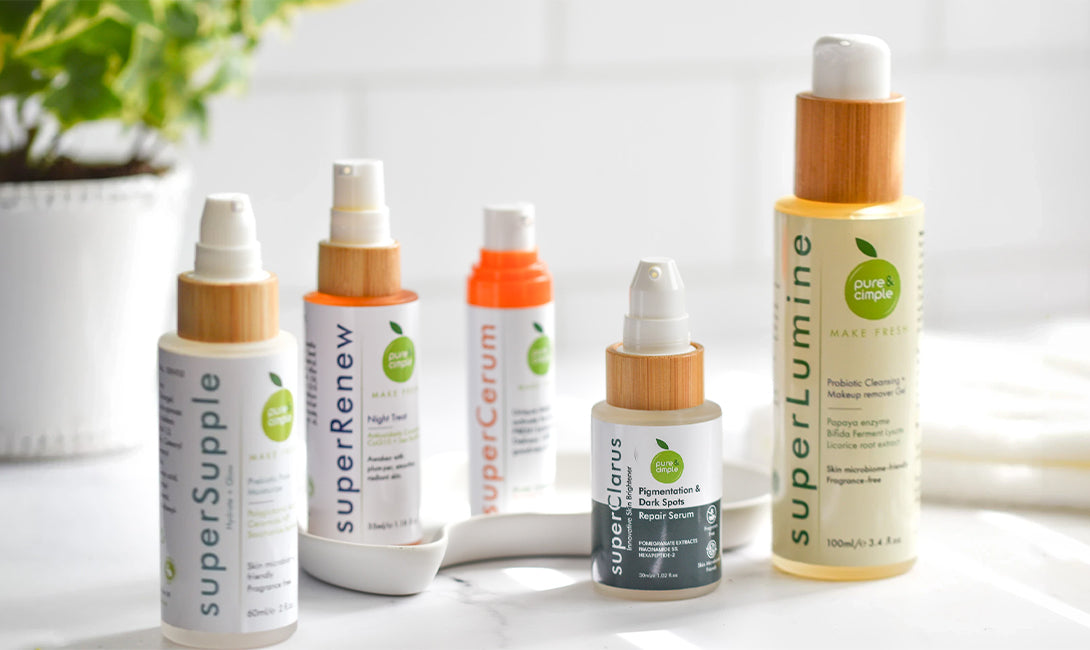
superLumine - our probiotic balmy cleanser. Gentle, microbiome-supportive, and fragrance-free.
superSupple - our daily triple-lipid barrier repair moisturiser with ceramides, cholesterol, free fatty acids and ectoin. Most barrier moisturisers contain only ceramides; superSupple contains all three lipid classes the barrier’s mortar is actually made of, in the ratio the skin needs to fully repair.
Two products. Twice a day. For at least seven days. Add nothing else until your barrier feels comfortable again. Once it does, you can gradually layer the rest of the Pure & Cimple range back in — every product is formulated to maintain the barrier you have just rebuilt, not test it.
Why do I have hyperpigmentation after 40, and how do I treat it?
Why do I have hyperpigmentation after 40, and how do I treat it?
Hyperpigmentation after 40 happens because oestrogen helps regulate melanin production, and as oestrogen fluctuates in perimenopause, pigment cells become more reactive. Sun, heat, inflammation and stress can now trigger patches that would not have appeared a decade ago. Treating it requires both prevention (rigorous daily SPF) and gentle, sustained intervention (vitamin C, niacinamide, and pigment-targeting peptides) over 12 weeks or more.
The biology - why oestrogen regulates pigment
Melanocytes (the cells that produce skin pigment) have oestrogen receptors. When oestrogen levels are stable, melanocyte activity is well-regulated and predictable. When oestrogen fluctuates - as it does throughout perimenopause and into menopause - melanocytes become less stable. They can over-produce pigment in response to triggers that would have been benign in your 30s.
This is why women often see pigmentation appear or worsen for the first time in their 40s, even when their sun exposure habits haven’t changed.
The four types of midlife hyperpigmentation
1. Sun-induced (solar lentigines, “age spots”). The classic flat, brown patches on cheeks, hands, chest. Cumulative UV damage from years of exposure.
2. Melasma. Larger, blotchy patches, usually symmetrical across the cheeks, forehead, or upper lip. Strongly hormonal - often appears or worsens in pregnancy or perimenopause. Particularly common in women with deeper skin tones.
3. Post-inflammatory hyperpigmentation (PIH). Pigment that appears after a breakout, irritation, or injury heals. More common in midlife because inflammation lasts longer in compromised skin.
4. Hormonal/cyclical pigmentation. Patches that flare with hormonal shifts during the menstrual cycle (still happening in perimenopause), heat, or stress.
Most midlife women have a mix of types, not just one — which is one reason single-ingredient treatments often disappoint.
Why melasma in particular shows up in perimenopause
Melasma is the most strongly hormone-driven of the pigmentation types. It’s triggered by oestrogen fluctuation and can appear for the first time in perimenopause, or worsen significantly if a woman had it during pregnancy. It’s harder to treat than other types because the underlying driver - hormonal - is internal, not external. But it is responsive to consistent treatment.
Triggers in midlife to be aware of
Beyond UV, three triggers matter more than they did a decade ago:
Heat. Saunas, hot showers, hot yoga, even cooking heat can trigger melasma. Visible-light heat is its own pigment trigger, separate from UV - which is why an indoor day at a hot stove can flare melasma even with no sun exposure.
Inflammation. A breakout, an irritated skin patch, a reaction to a product - all can trigger PIH that lingers for months. This is one reason fragrance and essential oils matter more in midlife: any inflammatory response can leave pigment behind.
Stress. Cortisol drives MSH (melanocyte-stimulating hormone), which directly increases pigment production.
The treatment approach: prevention plus intervention
Prevention is the foundation. Rigorous daily SPF (mineral, broad-spectrum, SPF 30 minimum). Wear it inside as well as outside — visible light from windows still triggers pigment. Reapply if you’re outside. This is non-negotiable; without it, no treatment ingredient will work, because new pigment forms faster than existing pigment is lifted.
Intervention works through three mechanisms: reducing pigment production at the melanocyte level, supporting the skin’s own pigment-clearing pathways, and gently accelerating cell turnover to lift existing pigment.
Ingredients that work
Vitamin C (L-ascorbic acid or stable derivatives). Inhibits tyrosinase (the enzyme that produces melanin). Use in the morning, layered under SPF.
Niacinamide. Reduces the transfer of melanin from melanocytes to skin cells. Excellent daily ingredient, well-tolerated by sensitive skin.
Alpha-arbutin. A gentler tyrosinase inhibitor than older agents like hydroquinone, with significantly fewer side effects.
Tranexamic acid. Particularly effective for melasma. Can be used topically or, with a clinician, orally.
Hexapeptide-2 and pigment-targeting peptides. Modulate melanin production at the signalling level — newer-generation actives with strong tolerance profiles.
Bakuchiol. Gentle cell turnover that lifts surface pigment without barrier irritation, unlike retinol.
Why bleaching agents (hydroquinone) are problematic
Hydroquinone is effective but comes with risks: long-term use can cause ochronosis (paradoxical darkening), skin thinning, and sensitisation. In many countries it’s prescription-only or banned in cosmetics. For midlife skin — already barrier-compromised and reactive — the modern alternatives (alpha-arbutin, tranexamic acid, peptide complexes) are safer and nearly as effective with consistent use.
Realistic timeline
You will not see dramatic results in two weeks. Pigmentation responds to sustained, consistent treatment over 12 weeks minimum. For melasma, expect 3–6 months. The trade-off is that the gentler approach (vs hydroquinone) means slower visible change but no rebound darkening or barrier damage.
Where Pure & Cimple fits
Three products work together for hyperpigmentation:
superCerum - pure vitamin C with ferulic acid for daytime tyrosinase inhibition.
superClarus skin brightener - pomegranate enzyme + hexapeptide-2 for targeted pigment modulation.
superLumine cleanser + makeup remover - papaya enzyme + Bifida ferment for gentle daily cell turnover and microbiome support.
All formulated fragrance-free and essential-oils-free, because for midlife pigmentation-prone skin, fragrance-induced inflammation is itself a pigment trigger. The same care that makes a formulation safe for a damaged barrier makes it safe for a melanin-reactive complexion.
Why is my skin suddenly so dry - even with moisturizer?
Why is my skin suddenly so dry - even with moisturizer?
Your skin is suddenly dry despite moisturizer because the dryness isn’t a moisturizer problem - it’s a
barrier problem. In midlife, declining oestrogen reduces ceramide, cholesterol, and free fatty acid production. Without those lipids, your skin can’t hold the moisture you’re applying. The moisturiser
delivers hydration to a leaky barrier; the hydration evaporates faster than you can replenish it.
Hydration vs moisturization - they’re not the same thing
These two words are used interchangeably in skincare marketing but they mean different things, and the distinction matters when your skin is dry.
Hydration is water content in skin. Humectants (hyaluronic acid, glycerin, urea) draw water into skin and increase hydration.
Moisturization is the act of preventing water loss from skin. Occlusives (lipids, oils, ceramides, butters) seal the surface and stop water from evaporating.
In midlife, the issue isn’t usually a hydration shortage - you can apply all the hyaluronic acid in the world and it won’t fix the dryness. The issue is moisturization: your skin has lost the lipid mortar that
keeps water inside. Water you apply just leaves.
Why this happens in midlife
Three biological shifts converge:
1. Oestrogen decline reduces ceramide synthesis. Ceramides make up roughly 50% of the lipid matrix that holds your skin barrier together. With less of them, the matrix becomes leaky.
2. Cholesterol and free fatty acid production also slow. These are the other 25% and 15% of the lipid matrix. The whole structure thins, not just the ceramide component.
3. Hyaluronic acid production drops. Your skin’s deeper water-holding mechanism shrinks. So even though you can add hyaluronic acid topically, your skin’s own reservoir is smaller than it was.
The combination means: less water-holding capacity, less ability to seal what’s there, faster evaporation. Apply moisturizer, surface feels softer for an hour, dryness returns.
Why MORE moisturizer doesn’t fix it
The instinct is to apply more product or thicker product. That helps temporarily but doesn’t address the underlying problem: a barrier that can’t hold what you’re applying. Layering five hydrating products on a
leaky barrier is like pouring water into a colander.
What works is replacing what’s missing. The lipids your skin can no longer produce in adequate quantities need to come from outside.
The right approach: replace the lipids, not just the water
For midlife dryness, the routine needs three things working together:
1. A humectant (water-binding) ingredient like hyaluronic acid, glycerin, or polyglutamic acid. Adds water to skin.
2. Lipid replacement. Triple-lipid (ceramides + cholesterol + free fatty acids) moisturiser. This is the critical one - and the one most “moisturizers” miss. They have ceramides but skip cholesterol and fatty acids.
3. An occlusive layer to seal it in. For severe dryness, a final layer of a richer moisturiser, balm, or facial oil at night.
Applied in this order, you add water, replace the missing lipids, and seal everything in.
Specific ingredients that work
• Ceramides (especially ceramide NP, AP, and EOP - the same forms found in skin).
• Cholesterol - often missing from “ceramide moisturisers.”
• Free fatty acids (linoleic acid, oleic acid).
• Hyaluronic acid - multi-weight versions for both surface and deeper hydration.
• Polyglutamic acid - holds 4x more moisture than HA.
• Beta-glucan - barrier-supportive humectant.
• Squalane - biomimetic to skin’s own sebum, reinforces barrier.
• Ectoin - protects cells from environmental moisture loss.
Routine adjustments
If your skin is suddenly dry despite using moisturiser:
1. Switch your moisturiser to a triple-lipid formulation if it’s currently a single-lipid (ceramide-only) cream.
2. Apply on damp skin. Moisturiser locks in water you’ve just applied; on dry skin it has less to lock in.
3. Layer for evening: hydrating serum (HA), then triple-lipid moisturiser, then a final facial oil or balm.
4. Reduce hot water exposure. Hot showers strip lipids more than cool ones.
5. Cut anything stripping. Sulfate cleansers, alcohol toners, daily acid exfoliation, fragrance-loaded products.
Where Pure & Cimple fits
superSupple is our triple-lipid barrier repair moisturiser — ceramides, cholesterol, free fatty acids, plus ectoin and squalane. It addresses midlife dryness at its actual cause (lipid deficiency) rather than just adding water. For severe dryness, layer superRenew (bakuchiol oil) over superSupple at night for the additional occlusive seal. Both fragrance-free, essential-oils-free, microbiome-friendly - because midlife dry skin is also reactive skin, and adding more inflammation through fragrance only worsens the dryness.


Restore What Midlife Takes

superPeptide | GHK Copper Peptide Serum

superSupple Prebiotic Triple Lipid Moisturizer


superLumine Probiotic Cleanser + Makeup Remover

superClarus Innovative Skin Brightener Serum


Vēda-Led. Science-Perfected. Restore what midlife takes.