


The third option
Still trying one drugstore moisturizer after another, hoping the next one will finally suit your skin? Or drawn to dermatologist-promoted products with $300–$400 price tags?
You deserve a third option: thoughtfully formulated skincare for your changing midlife skin, at prices that make everyday care accessible.
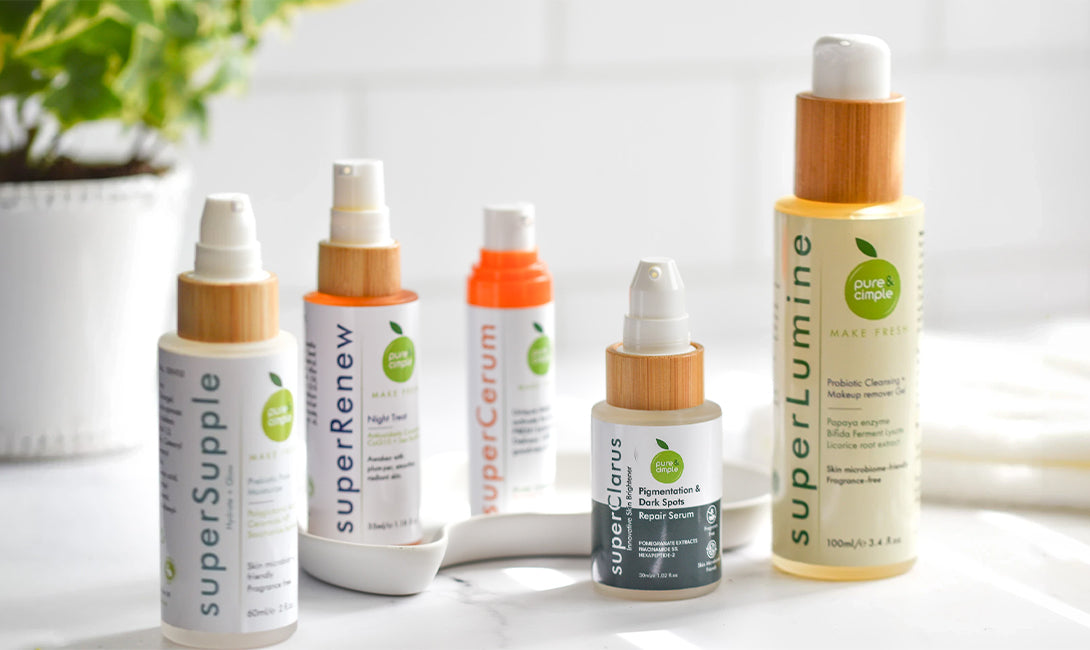
I know that search. My longtime moisturizer started to sting, and I developed rosacea for the first time in my life. I created Pure & Cimple to offer the care I was looking for.
Whether you’re finding your own routine or choosing everyday skincare alongside your dermatologist’s visits, Pure & Cimple was created with you in mind.
— Preeti , Founder












Real Results, Real Glow


Morning & Evening 3-Step Rituals
Morning & Evening 3-Step Rituals
Over 1,000 Positive Reviews

Liz T.
I've been using the superSuple Moisturizer for a few weeks now, and I can honestly say it's a game-changer for my skincare routine! The texture is rich but not greasy, and it absorbs beautifully into the skin. My face feels hydrated all day without that heavy or sticky feeling that some moisturizers leave behind.


Michael
superClarus has truly transformed my skin! The serum's non-greasy texture absorbs effortlessly into the skin, leaving it hydrated and refreshed. With consistent use, my complexion has noticeably brightened, and dark spots are fading.


Jessica G.
This probiotic cleanser is a game changer! I am very aware of the ingredients that are in the products I’m using on my skin and this cleanser is magic. I was searching the market for a cleanser to add into my routine that would help nourish my skin and remove makeup.


Francine T.
This lightweight formula hydrates the skin without clogging pores. It's appropriate for all skin types, including delicate or highly sensitive skin. The formula is free from fragrance and essential oils, which makes it gentle and non-irritating. It's also sustainable, organic, vegan, eco-friendly, safe, and kind to both your skin and the planet.

Create Your Skincare Ritual


Skincare Journal

How to Use GHK-Cu Peptide
GHK-Cu is usually applied after cleansing and before moisturizer. Depending on the product, you may use it in the morning or evening. For the best experience, apply a small amount to clean skin and allow it to settle before moving to the next step. For Pure & Cimple superPeptide, we recommend keeping pure L-ascorbic acid, direct exfoliating acids and retinoids out of the same application step. You can use them at a different time of day or on alternate days. That is the simple answer. However, learning where GHK-Cu fits into your routine can help you use it consistently without overwhelming your skin. What is GHK-Cu peptide? GHK-Cu is a small peptide made from three amino acids bound to copper. It occurs naturally in the body and appears as Copper Tripeptide-1 on cosmetic ingredient lists. In skincare, GHK-Cu acts as both a signal peptide and a carrier peptide. It is used to support the skin’s own collagen-related repair and remodeling processes and may help improve the appearance of firmness, fine lines, elasticity and uneven texture over time. GHK-Cu is one member of a much larger ingredient family. If you would like to understand the differences between peptide types, read our guide to what peptides are and how they work in skincare. How do you use GHK-Cu? Always begin by reading the directions for your specific serum. Products can vary in their concentration, pH and supporting ingredients. A simple routine will usually follow these steps: Step one: Cleanse your skin Start with a gentle cleanser to remove makeup, sunscreen, excess oil and other daily buildup. Avoid using a harsh scrub before applying GHK-Cu. Over-cleansing or exfoliating the skin may leave it feeling dry. Step two: Apply your GHK-Cu serum Apply the recommended amount of serum across your face and neck. Keep the product away from your eyes unless the directions state that it is suitable for the eye area. For Pure & Cimple superPeptide, apply one pump to clean, damp skin. Gently pat the serum in and allow it to settle or dry down for around 30 to 40 seconds before applying moisturizer. There is no need to use a large amount. Applying extra serum will not necessarily produce faster results. Step three: Apply moisturizer Follow your GHK-Cu serum with a moisturizer. This helps support the skin barrier and seal in hydration. Choose a moisturizer that suits your skin type. A richer cream may help dry or mature skin, while a lighter lotion may be more comfortable for oily or combination skin. Step four: Use sunscreen in the morning If you apply GHK-Cu during your morning routine, finish with a broad-spectrum sunscreen. Peptide skincare does not replace sun protection. Regular exposure to ultraviolet light can contribute to changes in skin texture, pigmentation, collagen and elasticity. Should you apply GHK-Cu to wet or dry skin? This depends on the product. Some GHK-Cu serums are intended for dry skin. Pure & Cimple superPeptide should be applied to clean, damp skin. Its sodium hyaluronate and other humectants help attract and retain moisture. After cleansing, gently pat away excess water before applying the serum. Should you use GHK-Cu in the morning or at night? You can use many GHK-Cu serums in either the morning or evening. The right time depends on your wider routine. Morning use may suit you if your evening routine already contains a retinoid or exfoliating acid. Evening use can be helpful if you apply pure L-ascorbic acid vitamin C in the morning. The most important point is consistency. Choose a time that allows you to use your serum regularly. A simple morning GHK-Cu routine Your morning routine could include: Gentle cleanser GHK-Cu serum Moisturizer Broad-spectrum sunscreen If you use a toner or hydrating essence, apply it after cleansing and before your serum. For superPeptide, keep highly acidic exfoliating toners out of the same application step. A simple evening GHK-Cu routine Your evening routine could include: Cleanser Hydrating toner or essence, if used GHK-Cu serum Moisturizer Facial oil, if needed An oil usually goes near the end of your routine because it can form a more occlusive layer over the skin. How often should you use GHK-Cu? Many GHK-Cu serums are designed for daily use. However, sensitive skin may benefit from a slower introduction. Start by applying it two or three times during the first week. If your skin remains comfortable, gradually increase to daily use. Introducing one new product at a time makes it easier to understand how your skin responds. It can also help you identify the cause if dryness, redness or irritation develops. What should you not mix with GHK-Cu? Compatibility guidance can vary between formulas. Always follow the directions for the individual product rather than applying one rule to every copper peptide serum. Pure & Cimple recommends keeping pure L-ascorbic acid, direct exfoliating acids and retinoids out of the same application step as superPeptide. This is product-specific guidance rather than a universal rule for every copper peptide serum. Pure vitamin C For superPeptide, avoid applying pure vitamin C in the form of L-ascorbic acid in the same application step. L-ascorbic acid formulas are usually acidic. Using the products at different times also keeps the routine simple and may be more comfortable for sensitive skin. You can still include both ingredients in your wider skincare routine. Try using: Pure vitamin C in the morning and superPeptide at night superPeptide in the morning and pure vitamin C at night Each active on different days if your skin is sensitive Not every vitamin C derivative is the same as L-ascorbic acid. Check the product label and follow the guidance provided by both manufacturers. Direct exfoliating acids For superPeptide, keep direct exfoliating acids out of the same application step, including: Glycolic acid Lactic acid Mandelic acid Salicylic acid Strong AHA or BHA peeling treatments Direct acids can make sensitive skin feel dry or uncomfortable. Use them on different days or in a separate routine from superPeptide. For example, you could use GHK-Cu most evenings and reserve one evening each week for your exfoliating acid. Your ideal frequency will depend on your skin and the strength of the exfoliant. Retinol and other retinoids Pure & Cimple recommends keeping superPeptide and retinoids in separate application routines. If you already use retinol, you could apply GHK-Cu in the morning and retinol at night. You could also alternate them on different evenings. Separating the products can make the routine easier to manage and may reduce the chance of irritation, especially if your skin is dry, mature or reactive. This is a conservative routine recommendation, not a claim that every retinoid deactivates every GHK-Cu formula. Which ingredients can you use with GHK-Cu? GHK-Cu can fit into a gentle routine containing hydrating, soothing and barrier-supporting ingredients. Depending on the complete formula, useful partners may include: Hyaluronic acid Glycerin Niacinamide Ectoin Centella asiatica Ceramides Bifida ferment lysate Moisturizing oils Sunscreen You may not need to buy each of these ingredients separately. A well-designed serum can combine peptides with several supporting ingredients. Pure & Cimple superPeptide combines Copper Tripeptide-1 and Palmitoyl Tripeptide-5 with niacinamide, ectoin, Centella asiatica, Bifida ferment lysate, sodium hyaluronate and other humectants. This allows you to add peptides, hydration and barrier support through one step. How long should you leave GHK-Cu on your skin? A GHK-Cu serum is normally a leave-on product. It should not be rinsed away unless the instructions say otherwise. Allow the serum to settle before applying moisturizer. Pure & Cimple recommends waiting around 30 to 40 seconds after applying superPeptide. Once the serum has settled and the skin no longer feels very wet, you can continue with your routine. The simple takeaway Apply GHK-Cu after cleansing and before moisturizer. Depending on the product, you may use it in the morning or evening. For superPeptide, apply one pump to clean, damp skin. Pat it in, allow 30 to 40 seconds for the serum to settle, and follow with moisturizer. If used in the morning, finish with sunscreen. For superPeptide, keep pure L-ascorbic acid vitamin C, direct AHA or BHA exfoliants and retinoids out of the same application step. You can use these products at a different time of day or on alternate days. Introduce GHK-Cu gradually if your skin is sensitive. Once your skin is comfortable, regular use will give you the best opportunity to assess how the product works within your routine. Frequently asked questions Can I use GHK-Cu every day? Many GHK-Cu serums are intended for daily use. If your skin is sensitive, begin with two or three applications during the first week and increase gradually if your skin remains comfortable. Can I use GHK-Cu with retinol? Compatibility depends on the finished formulas. For superPeptide, Pure & Cimple recommends using retinol in a separate routine—for example, superPeptide in the morning and retinol at night, or on alternate evenings. Can I use GHK-Cu with vitamin C? You can keep both in your wider routine. For superPeptide, use pure L-ascorbic acid vitamin C at a different time of day or on alternate days. Vitamin C derivatives are not identical to L-ascorbic acid, so check the directions for both products. Should GHK-Cu go on wet or dry skin? Follow the directions for your serum. Apply superPeptide to clean, damp—not dripping wet—skin. How long should I wait before applying moisturizer? After applying superPeptide, wait approximately 30 to 40 seconds, or until the serum has settled and the skin no longer feels very wet. Does GHK-Cu help the skin make collagen? GHK-Cu does not add collagen to the skin. As a signal and carrier peptide, it is used to support the skin’s own collagen-related repair and remodeling processes. Visible results depend on the complete formula, consistent use and the individual skin.
Learn more
How Long Does GHK-Cu Take to Work?
GHK-Cu does not transform the skin overnight. A well-formulated GHK-Cu serum may make the skin feel more hydrated within the first few uses, largely because of the hydrating ingredients in the complete formula. Changes in the appearance of texture, fine lines and firmness usually require more time. There is no clinically established timetable that applies to every GHK-Cu serum. Four to six weeks can be a useful progress-check point, while eight to twelve weeks is a more realistic window for assessing longer-term visible changes. Your skin, the complete formula and how consistently you use it will all affect the outcome. Here is what you need to know before judging whether your GHK-Cu serum is working. What is GHK-Cu? GHK-Cu is a small peptide made from three amino acids bound to copper. It occurs naturally in the body and is listed as Copper Tripeptide-1 in skincare products. GHK-Cu acts as both a signal peptide and a carrier peptide. It binds copper and is used to support the skin’s own collagen-related repair and remodeling processes. Over time, it may help improve the appearance of fine lines, firmness, elasticity and uneven texture. Results vary according to the formula and the individual skin. Learn more about what peptides are and how they work in skincare. How long does GHK-Cu take to show results? Four to six weeks is a useful point for checking your progress, but it is not a guaranteed deadline for visible results. Changes in the appearance of firmness, fine lines and overall skin quality are more reasonably assessed after eight to twelve weeks of consistent use. This does not mean nothing is happening before then. Some parts of a complete serum formula can provide quicker cosmetic benefits. Hydrating ingredients, for example, may make the skin look plumper and feel more comfortable soon after application. However, changes linked to the skin’s support structure are gradual. They should not be confused with the temporary plumping effect created by hydration. A realistic GHK-Cu timeline may look like this: The first one to two weeks This period is useful for learning how well your skin tolerates the product. Sensitive skin may benefit from starting with a few applications each week before moving to daily use. If the serum contains humectants and soothing ingredients, your skin may begin to feel: Softer Better hydrated More comfortable Less dry-feeling Temporarily plumper These early changes are often linked to the complete formula rather than GHK-Cu alone. Around four to six weeks At four to six weeks, use consistent lighting and the same viewing conditions to look for subtle changes in smoothness, texture or overall appearance. Not everyone will see a clear difference at this point. Any change may still be subtle. Hydration can make fine dehydration lines and surface texture look temporarily improved, so do not interpret every early change as structural remodeling. You may notice that the skin feels more comfortable or that makeup applies more smoothly. These are possible observations rather than guaranteed GHK-Cu results. Around eight to twelve weeks Eight to twelve weeks is a more useful window for reviewing possible visible changes in: Firmness Elasticity Skin texture Fine lines Overall skin quality Some small studies of topical products containing GHK-Cu have evaluated skin changes after approximately twelve weeks. Because those studies used different formulations, they do not establish an exact timeline for superPeptide or any other finished serum. Why does GHK-Cu take time to work? Hydration can change the way the skin looks quite quickly. Structural changes are slower. GHK-Cu is used as a signaling and carrier peptide. It binds copper and is associated with processes involved in skin renewal and extracellular-matrix remodeling. These processes take place gradually. This is different from an exfoliating acid, which may quickly make the surface feel smoother by removing dead skin cells. GHK-Cu takes a more supportive approach. That slower process is not necessarily a disadvantage. It can make copper peptides appealing to people who want to support mature skin without relying only on aggressive exfoliation. How can you track whether your serum is working? Take a baseline photograph and repeat it in the same lighting, at the same distance and from the same angle. Avoid introducing several new active products at once, so it is easier to understand what your skin is responding to. Separate tolerance from results. A product can feel comfortable before visible changes appear. Look for gradual changes in hydration, texture and the appearance of fine lines rather than expecting an overnight transformation. The simple answer So, how long does GHK-Cu take to work? You may notice improved hydration or comfort within the first few uses or first one to two weeks if the complete formula contains effective moisturizing ingredients. Four to six weeks is a useful progress-check point, but any visible change may be subtle. Eight to twelve weeks is a more realistic window for evaluating the appearance of firmness, fine lines and overall skin quality with consistent use. There is no exact schedule that applies to everyone. The formula, your skin and the rest of your routine all influence the outcome. Choose a well-formulated product, use it consistently and assess it over months rather than days. Ingredient research can help explain GHK-Cu’s potential, but results from one formulation cannot be assumed to apply identically to every finished serum. If you would like to add a 1% GHK-Cu serum to a barrier-conscious routine, explore superPeptide GHK-Cu + HA Pro-Collagen Serum. Frequently asked questions Can GHK-Cu work immediately? The complete serum may make the skin feel more hydrated or temporarily plumper soon after application. That immediate cosmetic effect should not be confused with gradual changes associated with the peptide. When should I check for visible results? Use four to six weeks as an early progress check and eight to twelve weeks as a more realistic evaluation window. These are guides rather than guaranteed deadlines. Why might my results take longer? Consistency, the finished formula, the rest of your routine, sun exposure and differences in individual skin can all influence the outcome. Does a stronger tingling sensation mean the serum is working? No. Tingling or irritation is not evidence that a peptide is more effective. If persistent redness, burning or discomfort develops, stop using the product and seek appropriate professional advice. How long should I keep using GHK-Cu before deciding? If the product remains comfortable, eight to twelve weeks of consistent use is a reasonable period for evaluating visible cosmetic changes. Stop sooner if irritation develops. Does GHK-Cu help the skin make collagen? GHK-Cu does not supply collagen directly. It is used to support the skin’s own collagen-related repair and remodeling processes, which is why any visible change should be judged over time.
Learn more
Collagen Cream vs. Peptide Serum: What’s the Difference?
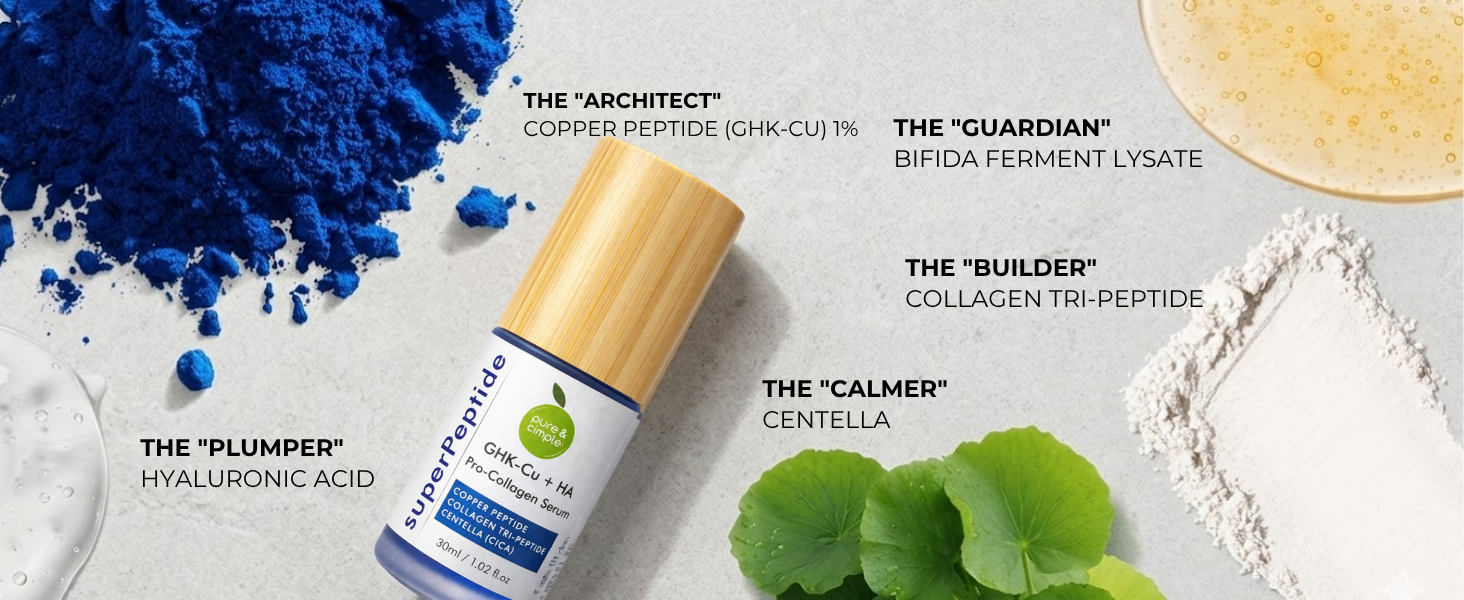
Collagen creams and peptide serums are not two versions of the same product. A collagen cream generally helps moisturize the skin and form a smoothing film on its surface. A peptide serum contains much smaller amino-acid chains selected for particular functions, including signaling and supporting the skin’s own collagen-production and remodeling processes. In simple terms: topical collagen mainly helps moisturize and smooth the skin’s surface, while selected peptides can help signal and support your skin’s own process of producing and remodeling collagen. Peptides do not turn into collagen or insert new collagen into the skin; they support the skin’s own collagen-related activity. That distinction matters, especially when you are choosing skincare for mature skin. First, what is collagen? Collagen is a large structural protein found throughout the body. In the skin, collagen fibers form an important part of the dermal support network that helps skin maintain its strength and firmness. Over time, the amount, quality and organization of collagen in the skin change. Natural aging plays a role, as do years of ultraviolet exposure and other environmental stressors. These changes can contribute to thinner-feeling skin, reduced elasticity and more visible lines. It is understandable to see the word collagen on a jar and assume the cream will put collagen back where it has been lost. But skin does not work quite that way. Does collagen cream put collagen back into your skin? No. Intact collagen is a very large molecule—far too large to pass readily through the stratum corneum, the skin’s outer protective layer. When collagen is applied in a conventional cosmetic cream, it does not travel into the dermis and become part of your existing collagen framework. That does not make topical collagen useless. Collagen can attract and retain water, and it can form a light film over the skin. Those properties may help: Reduce moisture loss from the surface Make dry skin feel softer and more comfortable Temporarily plump the look of fine dehydration lines Create a smoother surface appearance These are worthwhile moisturizing benefits. They are simply different from rebuilding the collagen structure beneath the skin’s surface. What about hydrolyzed collagen in skincare? Hydrolyzed collagen has been broken into smaller fragments. This makes it easier to incorporate into a cosmetic formula and can improve its water-binding properties. However, “smaller than intact collagen” does not automatically mean that every fragment reaches the deeper skin layers or stimulates new collagen. The size of the fragments, their structure, the delivery system and the rest of the formula all matter. Hydrolyzed collagen can still be a useful humectant or film-forming ingredient. It should not be described as broken collagen that simply enters the skin and reconstructs itself. What are peptides, and how are they different? Peptides are short chains of amino acids. Collagen is also built from amino acids, but it is a large, complex protein. Think of collagen as a finished architectural cable and a peptide as a short sequence with a more targeted role. Cosmetic peptides are chosen according to their structure and intended function. For example: Signal peptides help send messages associated with the skin’s extracellular matrix, including signals that support the skin’s own collagen synthesis and remodeling. Carrier peptides bind and carry trace elements. GHK-Cu, or Copper Tripeptide-1, binds copper and also has signaling activity associated with skin remodeling. Neurotransmitter-inhibiting peptides are used to soften the appearance of expression-related lines, although they do not work like injectable treatments. Enzyme-inhibiting peptides are studied for their influence on enzymes involved in various visible skin concerns. Peptides do not all do the same thing, and simply adding the word “peptide” to a label does not guarantee a particular result. Can peptide serums support collagen production? Yes - selected peptides are used in skincare because they can support biological signals associated with collagen production and extracellular-matrix remodeling. Their small size is one reason they can behave differently from intact topical collagen. A commonly cited principle in skin-delivery science is the “500-Dalton rule”: molecules below approximately 500 Daltons have a better chance of passing through the skin barrier than larger molecules. The specific GHK-Cu raw material used in Pure & Cimple superPeptide has a molecular weight of 401 Daltons, placing it below that commonly cited threshold. This number is specific to the GHK-Cu material used in our formula and should not be assumed for every GHK-Cu complex, blend or delivery form. Research using isolated human skin has also measured the penetration and retention of topically applied copper tripeptide. Molecular weight is important, but it is not the only factor. A peptide’s stability, concentration, charge, affinity for water and oil, the formula’s pH and delivery vehicle, and the condition of the skin barrier all influence how it is delivered and how well it performs. This is why the complete serum matters—not only the presence of a peptide on the ingredient list. GHK-Cu has been studied for its role in collagen-related signaling and skin remodeling, while Palmitoyl Tripeptide-5 is used as a signal peptide in pro-collagen skincare. In an appropriately designed formula, peptides such as these can support collagen-related skin processes and help improve the appearance of firmness, texture and fine lines. Results still depend on the specific peptide, formula and consistent use. Collagen cream vs. peptide serum at a glance Are peptides better than collagen cream for mature skin? It depends on what your skin needs. “Better” is not a useful comparison unless the goal is clear. If your skin feels dry, tight or rough, a well-formulated moisturizer may give you more immediate comfort than a treatment serum. A collagen cream can contribute moisturizing and smoothing benefits, although ingredients such as glycerin, ceramides, fatty acids and occlusives may be doing much of the barrier-supporting work in the complete formula. If your priority is the appearance of firmness, texture or fine lines, a thoughtfully formulated peptide serum may offer more targeted support. For many people in midlife, the most sensible answer is not one or the other. It is a targeted serum followed by a barrier-supporting moisturizer. Can you use a peptide serum and collagen cream together? Yes. In most cases, a peptide serum and collagen-containing moisturizer can be used in the same routine because they perform different jobs. A simple routine would be: Cleanse gently. Apply the peptide serum according to its directions. Follow with a moisturizer or collagen cream. In the morning, finish with broad-spectrum sunscreen. If your skin is sensitive, introduce one new formula at a time and patch-test first. Compatibility also depends on the complete formulas, not only the highlighted ingredients. What should you look for in a peptide serum? The ingredient list should identify the peptide rather than relying only on a vague “peptide complex” claim. It also helps when the brand explains why that peptide was selected and how to use the product. For mature, sensitive skin, consider the surrounding formula too. Look for: Humectants that attract water, such as glycerin or hyaluronic acid Ingredients selected to support a comfortable skin barrier A fragrance-free formula if fragrance is a trigger for you Clear directions for layering with other active products Realistic claims rather than promises of replacing lost collagen Concentration can be useful information, but it is not a quality score on its own. A stable, well-balanced finished formula matters. How Pure & Cimple superPeptide approaches the question Pure & Cimple superPeptide is designed as a targeted peptide serum rather than a topical collagen cream. It combines: Copper Tripeptide-1 (GHK-Cu), A copper-binding peptide with signaling activity associated with skin renewal and remodeling Palmitoyl Tripeptide-5, A signal peptide used in pro-collagen skincare Glycerin and sodium hyaluronate, Which help support hydration and create channel for GHK-Cu to go deeper in the dermis layer Niacinamide, ectoin, Centella asiatica extract and bifida ferment lysate, included in a formula designed with skin comfort and barrier support in mind The serum does not need to contain collagen to support collagen-related skin activity. Its GHK-Cu and Palmitoyl Tripeptide-5 system is designed to support the skin’s own collagen-production and remodeling processes, helping improve the appearance of firmness, smoothness and resilience. Hydrating and soothing ingredients also help care for dry or sensitive-feeling skin. For skin that needs more moisture, the serum can be followed with a barrier-supporting moisturizer. The simple answer A collagen cream and a peptide serum have different strengths. Choose a collagen cream - or another well-formulated moisturizer - when your main goal is surface hydration, softness and temporary plumping. Choose a peptide serum when you want targeted ingredients that help support your skin’s own collagen-related processes and the appearance of firmness, texture and fine lines. You do not need to choose between hydration and targeted care. Mature skin often benefits from both: a carefully formulated peptide serum followed by a moisturizer that helps the skin hold on to water and feel comfortable. The important difference is that topical collagen mainly works as a moisturizing, surface-smoothing ingredient, while selected peptides support the skin’s own biological processes associated with collagen. The peptide does not become collagen; it helps encourage the skin’s own collagen-related activity. Frequently asked questions What is the difference between collagen and peptides in skincare? Collagen is a large structural protein that mainly provides moisturizing and film-forming benefits when applied topically. Peptides are much shorter amino-acid chains selected for targeted functions. Certain peptides help signal and support the skin’s own collagen-production and remodeling processes, while carrier peptides such as GHK-Cu also bind copper. Can collagen cream penetrate the skin? Intact collagen is too large to penetrate readily through the skin’s outer barrier. It generally remains at the surface, where it can attract water and form a moisturizing film. Hydrolyzed collagen contains smaller fragments, but penetration and activity depend on their size and the finished formula. Does collagen cream rebuild collagen? No. Topical collagen does not enter the dermis and become part of the skin’s collagen framework. It can moisturize, smooth and temporarily plump the skin’s surface. Are peptides better than collagen for wrinkles? Selected peptides can support the skin’s own collagen-production and remodeling processes, making them more directly targeted to firmness and the appearance of fine lines. Results vary by peptide and formula. Collagen creams work differently and may temporarily soften dehydration lines by improving surface moisture. Can I use collagen cream with a peptide serum? Usually, yes. Apply the peptide serum first and follow with the cream or moisturizer. Always follow the directions for each product and introduce new formulas gradually if your skin is sensitive. Is GHK-Cu collagen? No. GHK-Cu is a short peptide bound to copper. It is generally listed as Copper Tripeptide-1 in skincare. It acts as a carrier peptide and also has signaling activity associated with skin remodeling. Does a peptide serum contain collagen? Not necessarily. A peptide serum does not need to contain collagen. Selected peptide chains can signal and support the skin’s own collagen-production and remodeling processes without becoming collagen themselves. Check the ingredient list for the exact peptides used.
Learn more


Stay Connected
Our story unfolds on Instagram. Be part of it!
Vēda-Led. Science-Perfected. Restore what midlife takes away.