What Should I Actually Be Using?
Honest ingredient breakdowns - what midlife skin needs, what to skip, and why the answer isn’t “stronger.”

The skincare aisle is full of noise. Retinol. Peptides. Vitamin C. Acids. Exosomes. PDRN. Every week a new hero ingredient trends. Most of it is not what midlife skin actually needs, and a surprising amount of it works against what your biology is trying to do.
This section strips the marketing off every ingredient that matters (and a few that don’t) and explains what each one does, why it does or doesn’t belong in a midlife routine, and which Pure & Cimple product uses it and how. No hype. No dressed-up science. Just the information I wish someone had written down for me when my own skin started to change.
Q & A
The questions other women are asking right now.
What is Bakuchiol, and is it really as good as retinol?
What is Bakuchiol, and is it really as good as retinol?
Bakuchiol is a plant-derived compound from the seeds of the Psoralea corylifolia plant that activates the same collagen and cell-turnover pathways as retinol, but without the irritation, photosensitivity, or barrier disruption. For midlife skin — which can no longer tolerate the friction of high-percentage retinol — it’s not a lesser alternative. It’s the better choice.
Where bakuchiol comes from
Bakuchiol (pronounced bah-KOO-chee-all) has been used in Ayurvedic and traditional Chinese medicine for centuries — long before Western skincare discovered it. It’s extracted from the seeds of the babchi plant, which grows across India, Sri Lanka, and parts of southern China. In Ayurveda, it has been used for skin healing, pigmentation, and inflammation.
How it works in skin
Bakuchiol is a functional analogue of retinol - meaning it’s structurally different (it’s not a vitamin A derivative), but it acts on similar gene expression pathways. Specifically, it upregulates Type I, III and IV collagen production, increases skin cell turnover, and boosts the synthesis of structural proteins like keratin and aquaporin-3.
The mechanism is different, but the result is comparable: firmer, smoother, more resilient skin.
The clinical evidence
The most-cited study is a 2018 trial published in the British Journal of Dermatology, which compared bakuchiol 0.5% twice daily to retinol 0.5% once daily over 12 weeks. The results: both groups showed the same significant reduction in wrinkles and pigmentation. But the bakuchiol group reported significantly less scaling, peeling, and irritation than the retinol group.
Multiple studies since have confirmed the same finding - bakuchiol delivers retinol-comparable anti-ageing results without the barrier disruption.
Why bakuchiol is particularly good for midlife skin
This is where bakuchiol becomes the clearly better choice - not just an alternative.
In perimenopause and menopause, the skin barrier is already weakened by declining oestrogen, falling ceramide production, and reduced lipid synthesis. Retinol — which works partly through controlled irritation — adds friction to a barrier that can’t afford it. Many women in their 40s find that the retinol they tolerated for fifteen years now triggers persistent redness, peeling, or sensitisation.
Bakuchiol gives you the collagen-signalling, cell-turnover, anti-pigmentation benefits without the friction. For a midlife barrier, that’s not a compromise — it’s the right tool for the right biology.
The practical advantages over retinol
- It’s not photosensitising, so you can use it morning AND evening.
- It’s safe in pregnancy and breastfeeding (retinoids are not).
- It doesn’t have a “purge” period when you start using it.
- It pairs well with vitamin C, which retinol traditionally doesn’t.
Where bakuchiol fits in a Pure & Cimple routine
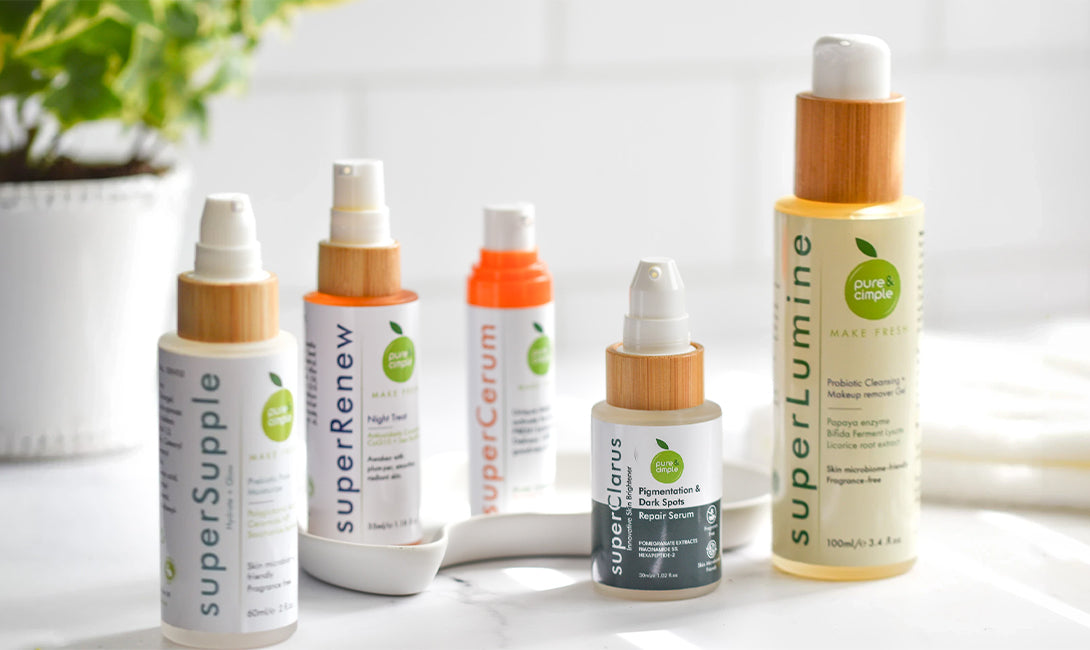
Bakuchiol is the active in superRenew, our night treatment face oil. We chose it deliberately because midlife skin needs the collagen signal without the barrier cost. The formulation is fragrance-free and essential-oils-free, so the active works without the sensitisation many “natural” bakuchiol oils introduce by adding lavender, rose, or citrus essential oils for scent.
Pair superRenew with superPeptide (GHK-Cu serum) for the collagen-rebuilding evening routine that midlife skin actually responds to.
What is GHK-Cu (copper peptide), and why does midlife skin need it?
What is GHK-Cu (copper peptide), and why does midlife skin need it?
GHK-Cu is a naturally occurring copper peptide - a tripeptide bound to a copper ion that signals the skin to repair, regenerate, and produce more collagen. In midlife, your body’s own GHK-Cu levels drop sharply, which is one of the reasons skin repair slows after 40. Topical GHK-Cu restores the signal your skin is no longer producing in adequate quantities on its own.
The biology
GHK-Cu (glycine-histidine-lysine copper) is found naturally in human plasma. It’s part of the body’s wound-healing system: when tissue is damaged, GHK-Cu concentrations rise locally to trigger repair. It signals fibroblasts to produce collagen and elastin, recruits immune cells, supports microcirculation, and reduces inflammation.
It’s one of the most-studied peptides in dermatological research over 40 years of clinical work, hundreds of published studies.
The age-related decline
By age 60, plasma concentrations of GHK-Cu drop by approximately 60% from their peak in your 20s. The decline isn’t a sudden drop; it’s a gradual slope through your 30s and 40s, reaching its steepest fall in perimenopause and post-menopause.
This decline maps directly to the slower repair, thinner skin, and reduced collagen turnover characteristic of midlife skin. It’s not the only factor, but it’s a meaningful one - and it’s the one topical GHK-Cu directly addresses.
What GHK-Cu does in skin
Four primary actions:
1. Stimulates collagen synthesis. Specifically Type I, III, and VI collagen — the structural proteins that give skin density and firmness.
2. Promotes elastin production. Restoring the “bounce-back” quality that diminishes in perimenopause.
3. Remodels the dermal matrix. It doesn’t just add new collagen; it signals the breakdown and replacement of damaged, stiff collagen fibres with high-quality new ones.
4. Reduces inflammation. Particularly relevant for the chronic low-grade inflammation (“inflammaging”) common in hormonal skin.
Why GHK-Cu is particularly important in perimenopause and menopause
Two reasons.
First, GHK-Cu addresses the structural decline directly. Where bakuchiol stimulates surface renewal and ceramides rebuild the barrier, GHK-Cu rebuilds the dermal architecture beneath. It’s one of the few commonly available topical actives that addresses skin density rather than just skin texture.
Second, it works without irritation. Unlike retinol or strong acids, GHK-Cu is anti-inflammatory by mechanism. It’s the rare anti-ageing active that calms the skin while it works — exactly what reactive midlife skin needs.
The concentration question
Most “copper peptide complexes” on the market are diluted - often 0.1% or less. At those concentrations, the peptide is on the label but probably not changing your skin’s structure. Research suggests 1% pure GHK-Cu is the clinical threshold needed for visible structural remodelling.
This is the difference between a marketing dose and a clinical dose, and it’s the single most important thing to look for when choosing a copper peptide product.
Why is the serum blue?
A high-purity GHK-Cu serum is naturally a deep sapphire blue. That colour is not a dye; it’s the natural hue of copper-tripeptide-1 at clinical concentration. If a copper peptide product is clear or pale, it most likely contains a very low dose. The intensity of the blue is, in itself, evidence of concentration.
Compatibility - what to use with, what to keep separate
GHK-Cu plays well with: hyaluronic acid, peptides, niacinamide, ceramides, beta-glucan, ectoin.
Keep separate from: high-acidity vitamin C (L-ascorbic acid) and exfoliating acids (glycolic, lactic, salicylic). Acidic ingredients can chelate the copper ion, breaking the bond and reducing efficacy. The simple solution: use vitamin C in the morning and GHK-Cu at night.
Where GHK-Cu fits in a Pure & Cimple routine
GHK-Cu is the active in superPeptide, our pro-collagen serum, formulated with 1% pure crystalline GHK-Cu — the clinical concentration, not a marketing dose. We deliberately formulated it without fragrance, essential oils, or any acidic ingredients that would compromise the peptide. The deep sapphire blue you see in the bottle is the natural colour of high-purity copper tripeptide-1.
Pair superPeptide with superSupple (our triple-lipid barrier repair moisturiser — ceramides, cholesterol, free fatty acids and ectoin) for morning use, and use superRenew in the evening routine instead of the same evening as the peptide.
What is Ectoin, and why is it suddenly in everything?
What is Ectoin, and why is it suddenly in everything?
Ectoin is a molecule produced by microorganisms that survive in extreme environments like salt lakes, deserts, and hot springs. In skincare, it surrounds skin cells with a protective hydration shell that shields them from pollution, UV, heat, blue light, and dehydration. It’s “suddenly in everything” because climate stress, screen time, and urban pollution have made its specific protective mechanism more relevant than it has ever been.
Where ectoin comes from
Ectoin is what’s called an extremolyte - a molecule produced by bacteria that survive in conditions hostile to most life: high salinity, extreme heat, intense UV. It was first discovered in 1985 in bacteria living in Egyptian salt lakes. The bacteria use ectoin to protect their proteins, DNA, and cell membranes from the environmental stress of their habitat.
The skincare insight: that same protective mechanism works on human skin cells.
How ectoin works
Ectoin is a kosmotrope - a molecule that organises water around itself. When applied to skin, it surrounds each cell with a structured hydration shell. This shell does three things:
- Holds water at the cellular level, preventing dehydration even under environmental stress.
- Stabilises cell membranes against heat, UV, and pollution damage.
- Reduces the inflammatory response to environmental triggers.
It doesn’t just hydrate the surface (the way glycerin does) or attract water from deeper layers (the way hyaluronic acid does). It physically protects the cells themselves from the stressors that age skin.
Why ectoin is suddenly “in everything”
Three forces converged in the early 2020s:
Climate stress. Heatwaves, UV intensity, and wildfire pollution have all increased measurably. Skin needs more environmental protection than it did a decade ago.
Pollution and urban living. Particulate matter, ozone, heavy metals - all proven contributors to oxidative damage and accelerated ageing.
The skin-barrier conversation. As consumers and dermatologists shifted from “more actives” to “protect the barrier,” ingredients with proven barrier-protection mechanisms moved from niche to mainstream.
Ectoin sits at the intersection of all three. It’s not hype - it’s a mature ingredient with two decades of clinical research that suddenly fits the moment.
Why midlife skin benefits especially
Midlife skin has a compromised barrier and a reduced ability to recover from environmental stress. Where a 30-year-old’s skin can shrug off a day of UV, pollution, or air-conditioned air, midlife skin retains the inflammatory consequence longer. Ectoin’s protective shell adds back the buffer that hormonal change has thinned.
It’s also one of the few barrier-supportive ingredients with strong clinical evidence specifically for hormonal skin reactivity — more relevant to perimenopausal and menopausal skin than the general anti-pollution category suggests.
Ectoin vs. hyaluronic acid
A common question. They do different things:
- Hyaluronic acid is a humectant - it draws moisture into the skin’s water-holding mechanism in the dermis.
- Ectoin is a cellular protectant - it holds water at and around skin cells, shielding them from environmental damage.
They’re complementary, not competing. The best routines for midlife skin use both.
The clinical evidence
Ectoin has a strong body of research, primarily from German dermatology labs. Documented benefits include reduced UV damage, protection against PM2.5 pollution, improvement in inflammatory skin conditions, faster barrier recovery after stress, and reduced trans-epidermal water loss. Studies have been published across atopic dermatitis, rosacea, and general environmental-stress dermatology.
Where ectoin fits in a Pure & Cimple routine
Ectoin is in three of our products: superSupple -our daily triple-lipid barrier repair moisturiser, where ectoin works alongside ceramides, cholesterol and free fatty acids to rebuild and protect the outer layer. And superPeptideo pro-collagen serum, where ectoin protects the peptide-stimulated cells from environmental stressors during the repair process) and superClarus skin brightener serum to protect cells from pigmentation caused by environmental damage.
We chose ectoin deliberately because we believe environmental protection is no longer optional for midlife skin - and because, like everything in our formulations, it is evidence-led, fragrance-free, and essential-oils-free.


Restore What Midlife Takes

superPeptide | GHK Copper Peptide Serum

superSupple Prebiotic Triple Lipid Moisturizer


superLumine Probiotic Cleanser + Makeup Remover

superClarus Innovative Skin Brightener Serum
Vēda-Led. Science-Perfected. Restore what midlife takes.