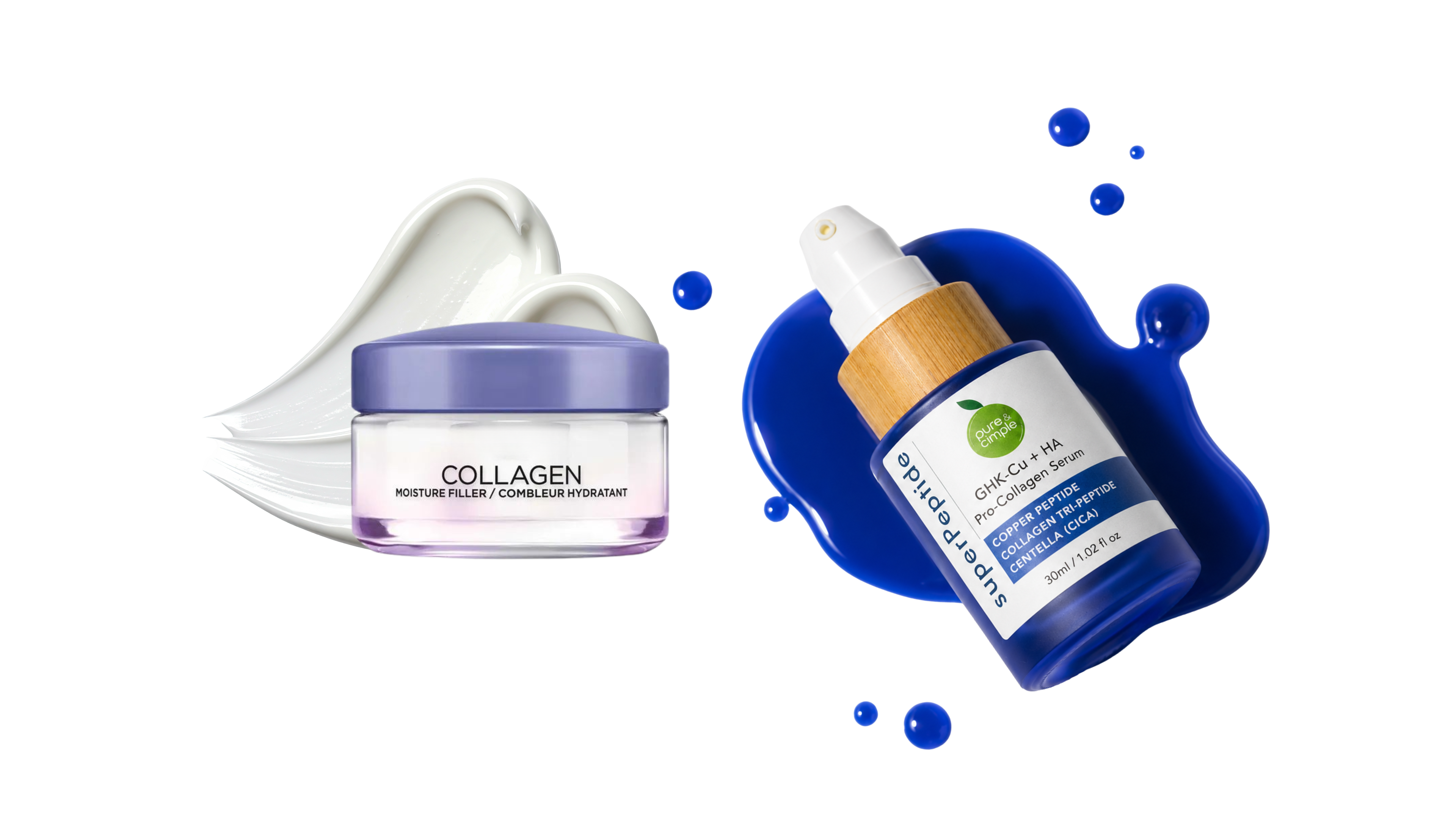
Collagen creams and peptide serums are not two versions of the same product. A collagen cream generally helps moisturize the skin and form a smoothing film on its surface. A peptide serum contains much smaller amino-acid chains selected for particular functions, including signaling and supporting the skin’s own collagen-production and remodeling processes.
In simple terms: topical collagen mainly helps moisturize and smooth the skin’s surface, while selected peptides can help signal and support your skin’s own process of producing and remodeling collagen. Peptides do not turn into collagen or insert new collagen into the skin; they support the skin’s own collagen-related activity.
That distinction matters, especially when you are choosing skincare for mature skin.
First, what is collagen?

Collagen is a large structural protein found throughout the body. In the skin, collagen fibers form an important part of the dermal support network that helps skin maintain its strength and firmness.
Over time, the amount, quality and organization of collagen in the skin change. Natural aging plays a role, as do years of ultraviolet exposure and other environmental stressors. These changes can contribute to thinner-feeling skin, reduced elasticity and more visible lines.
It is understandable to see the word collagen on a jar and assume the cream will put collagen back where it has been lost. But skin does not work quite that way.
Does collagen cream put collagen back into your skin?
No. Intact collagen is a very large molecule—far too large to pass readily through the stratum corneum, the skin’s outer protective layer. When collagen is applied in a conventional cosmetic cream, it does not travel into the dermis and become part of your existing collagen framework.
That does not make topical collagen useless. Collagen can attract and retain water, and it can form a light film over the skin. Those properties may help:
- Reduce moisture loss from the surface
- Make dry skin feel softer and more comfortable
- Temporarily plump the look of fine dehydration lines
- Create a smoother surface appearance
These are worthwhile moisturizing benefits.
They are simply different from rebuilding the collagen structure beneath the skin’s surface.

What about hydrolyzed collagen in skincare?
Hydrolyzed collagen has been broken into smaller fragments. This makes it easier to incorporate into a cosmetic formula and can improve its water-binding properties.
However, “smaller than intact collagen” does not automatically mean that every fragment reaches the deeper skin layers or stimulates new collagen. The size of the fragments, their structure, the delivery system and the rest of the formula all matter.
Hydrolyzed collagen can still be a useful humectant or film-forming ingredient. It should not be described as broken collagen that simply enters the skin and reconstructs itself.
What are peptides, and how are they different?
Peptides are short chains of amino acids. Collagen is also built from amino acids, but it is a large, complex protein. Think of collagen as a finished architectural cable and a peptide as a short sequence with a more targeted role.
Cosmetic peptides are chosen according to their structure and intended function. For example:
-
Signal peptides
help send messages associated with the skin’s extracellular matrix, including signals that support the skin’s own collagen synthesis and remodeling. -
Carrier peptides
bind and carry trace elements. GHK-Cu, or Copper Tripeptide-1, binds copper and also has signaling activity associated with skin remodeling. -
Neurotransmitter-inhibiting peptides are used to soften the appearance of expression-related lines, although they do not work like injectable treatments.
-
Enzyme-inhibiting peptides are studied for their influence on enzymes involved in various visible skin concerns.
Peptides do not all do the same thing, and simply adding the word “peptide” to a label does not guarantee a particular result.
Can peptide serums support collagen production?
Yes - selected peptides are used in skincare because they can support biological signals associated with collagen production and extracellular-matrix remodeling. Their small size is one reason they can behave differently from intact topical collagen.

A commonly cited principle in skin-delivery science is the “500-Dalton rule”: molecules below approximately 500 Daltons have a better chance of passing through the skin barrier than larger molecules. The specific GHK-Cu raw material used in Pure & Cimple superPeptide has a molecular weight of 401 Daltons, placing it below that commonly cited threshold. This number is specific to the GHK-Cu material used in our formula and should not be assumed for every GHK-Cu complex, blend or delivery form. Research using isolated human skin has also measured the penetration and retention of topically applied copper tripeptide.
Molecular weight is important, but it is not the only factor. A peptide’s stability, concentration, charge, affinity for water and oil, the formula’s pH and delivery vehicle, and the condition of the skin barrier all influence how it is delivered and how well it performs. This is why the complete serum matters—not only the presence of a peptide on the ingredient list.
GHK-Cu has been studied for its role in collagen-related signaling and skin remodeling, while Palmitoyl Tripeptide-5 is used as a signal peptide in pro-collagen skincare. In an appropriately designed formula, peptides such as these can support collagen-related skin processes and help improve the appearance of firmness, texture and fine lines. Results still depend on the specific peptide, formula and consistent use.
Collagen cream vs. peptide serum at a glance

Are peptides better than collagen cream for mature skin?
It depends on what your skin needs. “Better” is not a useful comparison unless the goal is clear.
If your skin feels dry, tight or rough, a well-formulated moisturizer may give you more immediate comfort than a treatment serum. A collagen cream can contribute moisturizing and smoothing benefits, although ingredients such as glycerin, ceramides, fatty acids and occlusives may be doing much of the barrier-supporting work in the complete formula.
If your priority is the appearance of firmness, texture or fine lines, a thoughtfully formulated peptide serum may offer more targeted support.
For many people in midlife, the most sensible answer is not one or the other. It is a targeted serum followed by a barrier-supporting moisturizer.
Can you use a peptide serum and collagen cream together?

Yes. In most cases, a peptide serum and collagen-containing moisturizer can be used in the same routine because they perform different jobs.
A simple routine would be:
- Cleanse gently.
- Apply the peptide serum according to its directions.
- Follow with a moisturizer or collagen cream.
- In the morning, finish with broad-spectrum sunscreen.
If your skin is sensitive, introduce one new formula at a time and patch-test first. Compatibility also depends on the complete formulas, not only the highlighted ingredients.
What should you look for in a peptide serum?
The ingredient list should identify the peptide rather than relying only on a vague “peptide complex” claim. It also helps when the brand explains why that peptide was selected and how to use the product.
For mature, sensitive skin, consider the surrounding formula too. Look for:
- Humectants that attract water, such as glycerin or hyaluronic acid
- Ingredients selected to support a comfortable skin barrier
- A fragrance-free formula if fragrance is a trigger for you
- Clear directions for layering with other active products
- Realistic claims rather than promises of replacing lost collagen
Concentration can be useful information, but it is not a quality score on its own. A stable, well-balanced finished formula matters.
How Pure & Cimple superPeptide approaches the question
Pure & Cimple superPeptide is designed as a targeted peptide serum rather than a topical collagen cream.

It combines:
-
Copper Tripeptide-1 (GHK-Cu),
A copper-binding peptide with signaling activity associated with skin renewal and remodeling -
Palmitoyl Tripeptide-5,
A signal peptide used in pro-collagen skincare -
Glycerin and sodium hyaluronate,
Which help support hydration and create channel for GHK-Cu to go deeper in the dermis layer -
Niacinamide, ectoin, Centella asiatica extract and bifida ferment lysate,
included in a formula designed with skin comfort and barrier support in mind
The serum does not need to contain collagen to support collagen-related skin activity. Its GHK-Cu and Palmitoyl Tripeptide-5 system is designed to support the skin’s own collagen-production and remodeling processes, helping improve the appearance of firmness, smoothness and resilience. Hydrating and soothing ingredients also help care for dry or sensitive-feeling skin.
For skin that needs more moisture, the serum can be followed with a barrier-supporting moisturizer.
The simple answer

A collagen cream and a peptide serum have different strengths.
Choose a collagen cream - or another well-formulated moisturizer - when your main goal is surface hydration, softness and temporary plumping. Choose a peptide serum when you want targeted ingredients that help support your skin’s own collagen-related processes and the appearance of firmness, texture and fine lines.
You do not need to choose between hydration and targeted care. Mature skin often benefits from both: a carefully formulated peptide serum followed by a moisturizer that helps the skin hold on to water and feel comfortable.
The important difference is that topical collagen mainly works as a moisturizing, surface-smoothing ingredient, while selected peptides support the skin’s own biological processes associated with collagen. The peptide does not become collagen; it helps encourage the skin’s own collagen-related activity.
Frequently asked questions
What is the difference between collagen and peptides in skincare?
Collagen is a large structural protein that mainly provides moisturizing and film-forming benefits when applied topically. Peptides are much shorter amino-acid chains selected for targeted functions. Certain peptides help signal and support the skin’s own collagen-production and remodeling processes, while carrier peptides such as GHK-Cu also bind copper.
Can collagen cream penetrate the skin?
Intact collagen is too large to penetrate readily through the skin’s outer barrier. It generally remains at the surface, where it can attract water and form a moisturizing film. Hydrolyzed collagen contains smaller fragments, but penetration and activity depend on their size and the finished formula.
Does collagen cream rebuild collagen?
No. Topical collagen does not enter the dermis and become part of the skin’s collagen framework. It can moisturize, smooth and temporarily plump the skin’s surface.
Are peptides better than collagen for wrinkles?
Selected peptides can support the skin’s own collagen-production and remodeling processes, making them more directly targeted to firmness and the appearance of fine lines. Results vary by peptide and formula. Collagen creams work differently and may temporarily soften dehydration lines by improving surface moisture.
Can I use collagen cream with a peptide serum?
Usually, yes. Apply the peptide serum first and follow with the cream or moisturizer. Always follow the directions for each product and introduce new formulas gradually if your skin is sensitive.
Is GHK-Cu collagen?
No. GHK-Cu is a short peptide bound to copper. It is generally listed as Copper Tripeptide-1 in skincare. It acts as a carrier peptide and also has signaling activity associated with skin remodeling.
Does a peptide serum contain collagen?
Not necessarily. A peptide serum does not need to contain collagen. Selected peptide chains can signal and support the skin’s own collagen-production and remodeling processes without becoming collagen themselves. Check the ingredient list for the exact peptides used.