Welcome to 2024, a year brimming with potential! As we step into our 40s and beyond, skincare becomes more than a routine; it evolves into a form of self-care and empowerment. With unique changes our skin undergoes during these years, adopting targeted skincare habits is crucial. Inspired by James Clear's insightful "Atomic Habits," this guide is tailored for women over 40, focusing on integrating small yet impactful habits into their skincare regimen. These habits promise to enhance your skin's health and radiance, fitting effortlessly into your life's rich tapestry.
Β
Β
1. The One-Minute Skincare Rule:
Embrace the power of small beginnings with the one-minute rule, a cornerstone concept of atomic habits. For mature skin, this can be a game-changer. In the realm of skincare, one of the simplest and most crucial steps you can implement is the one-minute rule for SPF application. It takes less than a minute to apply sunscreen, but this quick step is monumental in protecting your skin from harmful UV rays, helping mature skin and maintaining an even skin tone. Incorporating SPF seamlessly into your routine is as simple as placing it next to your other skincare essentials. Having it in sight right after you use your serum makes it a natural step to follow. Remember, this small commitment of just one minute can lead to significant changes in maintaining your skinβs health and youthfulness.
Β
Β
2. Tailoring Your Routine for Mature Skin:
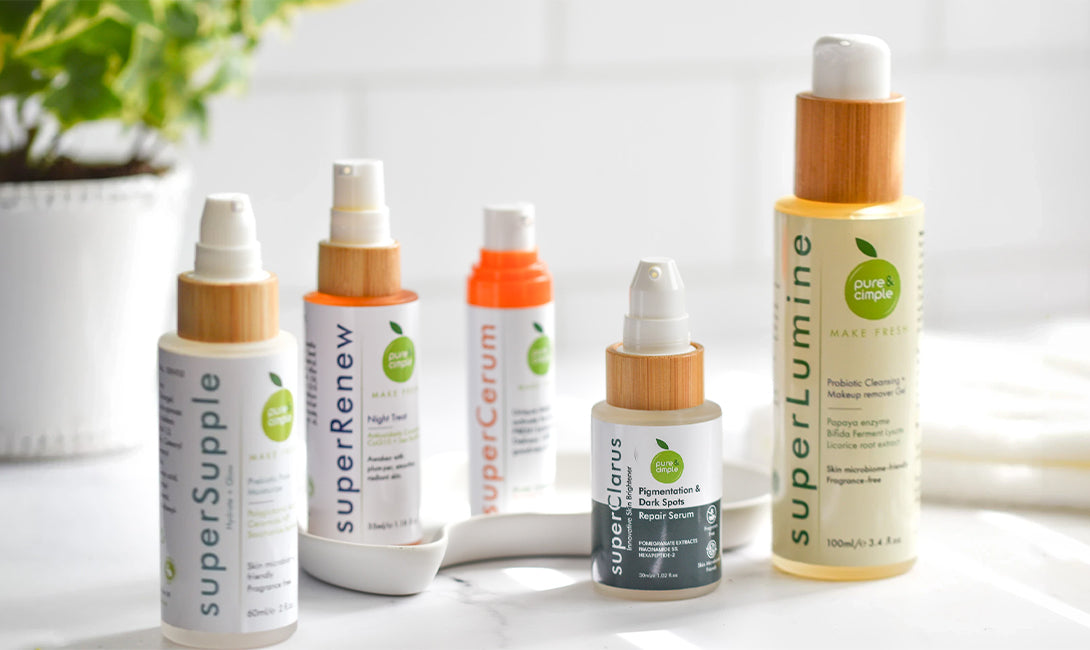
Habit stacking, a key principle in atomic habits, is particularly beneficial for skincare at this age. Mature skin requires special attention, and layering products correctly can maximize their benefits. After cleansing your face with a non-drying cleanser like superLumine, apply your superClarus serum (innovative serum with best of Ayurveda + Biomimetics), a hydrating moisturizer that can double up as skin barrier booster is essential, as mature skin often experiences dryness. Follow this with a broad-spectrum SPF, an indispensable step to protect your skin from photoaging. This methodical approach to skincare ensures that each product works harmoniously with the next, creating a ritual that nourishes your skin and soul.
Β
Β
3. Consistency: The Secret to Timeless Beauty:
Consistency in skincare routines is more influential than the complexity of the routine itself. Establishing a regular skincare schedule, both morning and night, is pivotal for women over 40. This age group benefits significantly from a consistent skincare routine, as it combats the signs of aging and maintains skin health. A simple, regular skincare ritual, even if it takes just a few minutes, can lead to dramatic improvements in skin elasticity and texture. Consistency in applying products ensures that your skin receives the nourishment it needs on a continuous basis.
Β
Β
Β
4. Visual Cues: A Reminder for Skincare:
In line with Clearβs principle of making good habits obvious, keep your skincare products in a visible spot. For women in their 40s and beyond, a visual reminder like a beautifully arranged skincare set on your vanity or bathroom counter can be the nudge needed to maintain your skincare routine. This tactic is particularly effective in ensuring that daily skincare becomes an ingrained part of your routine, thereby enhancing the health and appearance of your skin over time.
Β
Β
Β
Β
Β
5. Habit Stacking for Wellness and Skin Health:
Integrate your skincare habits with daily routines for efficiency and enjoyment. For instance, applying the superClarus serum while your morning coffee brews combines self-care with a daily ritual, making it an effortless part of your day. In the evening, use your skincare routine as a cue to unwind. Gently massaging your face with Pure & Cimpleβs superRenew Night Treat can be a relaxing practice, paired with your nightly routine of reading or meditation. This approach to habit stacking extends beyond skincare; it creates moments of mindfulness and self-care throughout your day, enhancing both your skin's health and your overall well-being.
Β
Β
Β
6. Track and Celebrate Your Progress:
Tracking progress is a motivational tool advocated by James Clear and is highly effective in skincare. Regularly taking photos weekly/monthly or keeping a skincare journal to document changes not only helps in noticing the benefits of your skincare routine but also in understanding your skin better to tweak your lifestyle. Celebrate each small victory, whether it's a reduction in fine lines, improved hydration, or a more even skin tone. These milestones, achieved through products like Pure & Cimpleβs nourishing range, are a testament to your commitment to skin health.
Β
Β
Β
7. Embracing Patience and Persistence: The Compound EffectΒ
The journey of skincare, especially in our 40s and beyond, requires patience and persistence. The principles of atomic habits remind us that results accrue over time. Consistently applying your skincare products will gradually yield noticeable improvements. In the realm of mature skincare, changes do not occur overnight. Itβs the compound effect of daily, diligent skincare habits that leads to lasting changes. Understand that every application is an investment in the future of your skin. Embracing this journey with patience will ensure that your skin reaps the benefits of your dedication.
Β Β
Incorporating atomic habits into your skincare routine paves the way for significant, lasting improvements. Start small, stay consistent, and embrace the journey with patience. Your dedication to skincare is a powerful act of self-care that promises radiant, healthy skin for years to come.
If youβre in your 40s or 50s and thinking: βWhy is my skin suddenly so dry?β
Β βWhy does everything sting now?β
Β βWhy did my old moisturiser stop working?β
β¦thatβs a real shift, and itβs common.
During perimenopause and menopause, skin often becomes drier and more reactive, which can make the barrier feel like itβs constantly βon edge.β In these phases, your skin does not need more actives - it need more resilience.
Thatβs where triple lipid barrier repair moisturisers come in (also called lipid replacement or barrier lipid therapy). The idea is simple:
Replenish the skinβs natural lipids in a balanced way so it can hold water, stay calm, and tolerate your routine again.
As formulators, this is the exact reason we built superSupple - not as a βresults overnightβ product, but as a daily barrier stabiliser. Weβll reference it as a real-world example (without turning this into a sales pitch), and you can use this guide to evaluate any product.
In a Hurry? Start Here⦠The 4 Things To Look For
If youβre in perimenopause/menopause and your skin is suddenlyΒ tight, flaky, stingy, or βreacting to everything,β youβre not doing anything wrong. Your skin is just asking for barrier support, not more actives
Hereβs the simple checklist Iβd use:
Step 1: Look for the βBarrier Trioβ - Ceramides + Cholesterol + Fatty Acids (this is what βtriple lipidβ really means)
Step 2: Add hydration that lasts - If youβre stuck in the βmoisturisedβ¦ then dry againβ loop, look for PGA (polyglutamic acid) + saccharide isomerate (they help hydration feel steadier on sensitive skin)
Step 3: Stop the daily triggers (for now) - Pause the stuff that keeps your barrier stressed: over-exfoliating, stacking actives, harsh cleansing, hot water, fragranceΒ
Step 4: Keep your routine simple and consistent for 2 weeks
Β Β Β - Gentle cleanse β barrier moisturiser β SPF (AM)
Β Β Β - Gentle cleanse β barrier moisturiser (PM)
Β
The Longer Story (Worth It)
Why perimenopause and menopause can make skin drier (and more sensitive)
Hormone shifts can change how skin behaves - especially its ability to:
retain moisture
feel comfortable day-to-day
reover after stress (actives, weather, cleansing, heat)
The result often looks like: tightness, flaking, redness, stinging, and βmy skin canβt tolerate what it used to.β Even people who were oily for decades can become oily-but-dehydrated (surface dryness + uncomfortable shine).
This is why βbarrier-firstβ becomes such a powerful strategy in midlife: when the barrier is supported, everything else becomes easier.
Β
What is the skin barrier, really?
Think of the outermost layer like a brick wall:
Bricks = skin cells
Mortar = lipids (fats) that hold everything together
When the βmortarβ is depleted or out of balance, water escapes and irritants get in. You may notice:
products stinging that never used to sting
dry patches that donβt respond to basic moisturisers
tightness after cleansing
redness or βflushy heatβ
makeup sitting worse than usual
βmoisturised for an hourΒ β dry againβ
Β
The 3 barrier lipids (Triple Lipid) your skin actually uses
1) Ceramides - the βsealantsβ:Β Ceramides help reduce water loss and support the barrierβs structure.
Low-ceramide vibes: dryness that returns quickly, rough patches, sensitivity spikes
2) Cholesterol -the βorganiserβ :Β Cholesterol supports flexibility and repair - a barrier canβt function well if itβs brittle.
Low-cholesterol vibes: tightness, reactivity, βmy skin canβt bounce backβ
3) Free fatty acids -the βsmoothersβ :Β Fatty acids support barrier integrity and comfort, improving softness and resilience.
Low-fatty-acid vibes: flaking, dullness, uncomfortable dryness, rough texture
Hereβs the simple but important distinction:Β Hydration fills the tank. Lipids fix the tank.
Many moisturisers hydrate well, but when midlife skin becomes sensitive, it often needs lipids to actually hold onto hydration and remain calm.
Β
Whatβs with ratios like β2:4:2β?
You might see ratios describing the balance of ceramides : cholesterol : fatty acids.
The takeaway isnβt βhunt for a perfect ratio.β Itβs:
Balance matters
Consistent tolerance matters more than chasing a trend
If your skin is reactive, the βbestβ triple lipid is the one you can use daily without stinging.
Β
In midlife, βhydration styleβ matters as much as hydration amount
A big frustration in perimenopause/menopause dryness is that hydration can feel:
great for 30β60 minutesβ¦ then gone
or worse: βhydratingβ products can sting because the barrier is stressed
Thatβs why we like pairing barrier lipids with long-wear hydration that feels steady.
PGA (Polyglutamic Acid) / Glycerine / Hyaluronic acid
A humectant that helps hold water at the surface and gives a cushiony comfort feel - especially when skin feels tight or sensitised.
Saccharide Isomerate (prebiotic-style hydrator)
A sugar-derived hydrator known for long-lasting moisture, helpful if you get the βdry again in two hoursβ cycle. Itβs often positioned as microbiome-friendly and sustained release of hydrator keeping moisture in for 72 hours.
These donβt replace lipids - they support comfort while the barrier rebuilds.
Β
What a βmidlife barrier repairβ formula looks like (example)
A lot of βbarrier creamsβ rely mainly on heavy occlusion. That can feel soothing, but a midlife barrier-support formula often works best as a system:
Example (our approach inΒ superSupple):
β’ A balanced tri-lipid system (ceramide + cholesterol + free fatty acids)
β’ Hydration supporters like glycerin + propanediol
β’ Panthenol for comfort support
β’ Ectoin for βoverstimulated skinβ phases
β’ PGA for cushiony water-holding feel
β’ Saccharide isomerate for long-wear hydration between applications
Why this matters: triple lipids help rebuild the βmortar,β while PGA + saccharide isomerate help midlife dryness feel less relentless day-to-day.
(Not a requirement to choose superSupple β use this as a blueprint for what to look for.)
Β
Who benefits most from triple lipids in perimenopause/menopause?
Youβre a strong candidate if:
β’ your skin became drier and more sensitive in your 40s/50s
β’ you get stinging from products you used to tolerate
β’ you reapply moisturiser constantly
β’ your skin feels raw after cleansing
β’ youβre using retinoids/exfoliants but canβt tolerate them anymore
β’ you feel stuck in βcalm for a day β flare againβ
Β
The most common mistake: adding barrier products but keeping barrier stress
If youβre rebuilding sensitivity-prone midlife skin, youβll usually do better by temporarily reducing:
β’ frequent exfoliation (AHA/BHA stacks)
β’ βactive cocktailsβ in one routine (vit C + retinoid + acids)
β’ harsh cleansing, hot water, long cleansing routines
β’ fragranced products / essential oilsΒ
Barrier repair works best when skin isnβt being re-triggered daily.
Β
A barrier-repair routine for perimenopause/menopause dryness (AM/PM)
Morning (steady + protective)
1. Gentle cleanse (or rinse if very dry)
2. Triple lipid moisturiser (thin layer)
3. Sunscreen
Night (repair-focused)
1. Gentle cleanse
2. Triple lipid moisturiser
3. Optional: add a simple oil on top if youβre very dry
If youβre using retinoids: Try the βsandwichβ: moisturiser β retinoid β moisturiser, and lower frequency before increasing strength.
Β
FAQs
Q: My skin is suddenly dry and reactive in perimenopause - what moisturizer should I use?
A: Perimenopause can make skin feel βsuddenlyβ drier and more reactive because hormonal shifts can reduce natural oils and slow barrier recovery. The best place to start is a barrier-repair moisturizer that does two things:
Replaces missing skin lipids: look for ceramides + cholesterol + fatty acids (a βtriple lipidβ blend).
Limits irritation: choose fragrance-free, no essential oils, and no βtinglyβ actives if youβre sensitized.
If your skin is flaring, keep the routine boring for 2β3 weeks: a gentle cleanser, one barrier moisturizer, and daily sunscreen. Once your skin feels calm again, you can reintroduce actives slowly.
Quick rule: If your moisturizer stings on application, your barrier likely needs support first.
Β
Q: How do I know if my skin barrier is "damaged vs just dry?β
A: Dry skin and a damaged barrier overlap, but there are tell-tale differences.
It might be βjust dryβ if:
Tightness improves quickly after moisturizer
You donβt get stinging/itching from basic products
Flaking is mild and predictable (like winter dryness)
It might be barrier-impaired if you notice:
Stinging/burning when applying products (even ones youβve used before)
Redness, itchiness, or rashy patches
Skin feels dry again within hours, no matter what you apply
Youβve recently increased exfoliants/retinoids or over-cleansed
Makeup suddenly sits weird, pills, or highlights texture
Simple at-home test: Apply a plain, fragrance-free moisturizer to slightly damp skin. If it stings or your face feels βhot,β prioritize barrier repair before adding actives.
Β
Q:Β What ingredients actually repair the barrier?
A: When we say βbarrier repair,β we mean helping the outer layer of skin (stratum corneum) rebuild its protective structureβoften described asΒ βbricks and mortar.β The βmortarβ is largely lipids, and the most important ones to replenish are:
Ceramides: help seal gaps and reduce water loss
Cholesterol: supports flexibility and barrier organization
Fatty acids: help complete the lipid matrix and strengthen barrier function
Thatβs why ceramides + cholesterol + fatty acids together is such a powerful combo (often called triple lipid support).
Other barrier-supportive helpers (especially for sensitive midlife skin):
Humectants (glycerin, propanediol, polyglutamic acid) to pull water into skin
Panthenol (pro-vitamin B5) to soothe and support recovery
Ectoin (often used to reduce stress/inflammation feeling in reactive skin)
Prebiotics (like saccharide isomerate) to support a balanced, comfortable skin environment
Β
Q: Whatβs a good fragrance-free moisturizer for eczema-prone or very sensitive skin?
A: If youβre eczema-prone or extremely sensitive, aim forΒ fragrance-free, barrier-first formulas and avoid common irritants.
Look for:
Fragrance-free (and no essential oils)
Triple-lipid support (ceramides + cholesterol + fatty acids)
Soothing, low-irritation ingredients (panthenol, ectoin, gentle humectants)
A texture that feels comfortingβnot βactiveβ or tingly
Be cautious with:
Strong botanical fragrance components (lavender, citrus oils)
Overuse of exfoliants/retinoids during flares
Too many new products at once (introduce one at a time)
Pro tip: Patch test behind the ear or on the jawline for 2β3 nights, especially if your skin is currently reactive.
(And as alwaysβif you have true eczema flares or broken skin, itβs worth checking in with a dermatologist.)
Β
Q:Β How can I use tretinoin / retinol without irritation? Whatβs the sandwich method?
A: Barrier support is often the missing piece for people using tretinoin (or retinoids) who feel dry, irritated, or flaky.
The sandwich method is a simple way to reduce irritation:
Apply a thin layer of moisturizer on clean, dry skin
Apply a pea-sized amount of tretinoin (avoid corners of nose, mouth, and eyelids)
Finish with another thin layer of moisturizer
Two important details:
Start slow: 2β3 nights/week, then increase only if your skin is calm.
Wait until skin is dry before tretinoin if youβre sensitiveβapplying on damp skin can increase irritation.
If youβre still peeling or stinging: cut frequency, simplify everything else, and use a barrier-repair moisturizer daily until your skin feels steady again.
Β
Q: How long does barrier repair take?Β What to avoid during a barrier βresetβ?
A: Firstly AVOIDΒ strong exfoliating acids, harsh scrubs, high-fragrance products, and stacking too many actives at once to start barrier repair
You'll notice improvement
In 3β7 days: many people notice less tightness, less βsting,β and skin feels calmer if they stop irritants and simplify the routine.
In 2β4 weeks: flaking and rough texture often improve, and your skin holds moisture better.
In 4β8+ weeks: deeper resilience buildsβskin is less reactive to products and environmental triggers.
Signs youβre healing: products sting less, redness reduces, makeup sits better, dryness doesnβt come back within a few hours.
Simple βbarrier resetβ for 2 weeks: gentle cleanser β barrier-repair moisturizer (AM/PM) β sunscreen (AM). Once your skin feels stable, reintroduce actives slowly (every 3rd night β every other night, etc.).
Β
If youβre rebuilding your barrier, choose one triple lipid moisturiser and commit to it for a couple of weeks while you simplify everything else.
If you want a sanity check, write to us at welcome@pureandcimple.com with:
your top 3 symptoms (tightness? sting? flakes? heat?)
whether youβre using retinoids/exfoliants
your current AM/PM routine
Weβll suggest a simple barrier-first routine - even if that means using what you already own.
During menopause, skin loses up to 30% of its collagen in just 5 years. Peptides are the gentle, science-backed solution that stimulates collagen production without the irritation of retinolβperfect for sensitive, mature skin experiencing hormonal changes.
Your favorite moisturizer burns. Water stings. Even your gentlest cleanser leaves you red and angry.
If this sounds familiar, you're not suddenly "allergic to everything"βyour skin barrier is damaged, and there's a critical difference between this and normal dry or sensitive skin. For women over 40, hormonal changes make barrier damage more likely yet harder to identify, leading many to treat the problem incorrectly for months.
Understanding this distinction could be the key to finally getting your skin back on track. Damaged barriers require a completely different approach than typical dryness, and using the wrong strategy will only make the problem worse.
Ready to decode what your skin is really telling you?